Posted by Debbi Cohen on Wed, Jul 21, 2010 @ 03:20 PM
ASTM F2256 describes in detail how to prepare and test tissue adhesives. This standard describes the methods used to compare and characterize different types of adhesives and for manufacturing quality control of the tissue adhesive based medical devices.
Medical professionals are now using tissue adhesives in place of, or in addition to, the standard sutures or staples to close wounds, surgical openings, and other bandage or wound applications. Defining the adhesive strength of these products determines where, how, and when the adhesive can be used in a medical procedure.
Sample preparation for test substrates; frozen or split bovine, porcine, or ovine tissue freshly harvested from the target organ of a domestic animal. Sample preparation guidelines discussed in detail in section 6, 7, and 8. ASTM F2256

Test Procedure
- Sample specimen width 2.5 +-0.1 cm
- Sample specimen length 15 +-0.2cm (2.5 unbonded, 12.5cm bonded)
- 10 specimens - individual tests and results accumulate with a statistical summary. In some cases, more samples may be needed to obtain a more accurate measure of mean strength.
- Condition specimens for 1 hour +-15 min.A)Tissue Adhesive -internal use-37 degrees Celcius in phosphate buffered saline. B)Tissue Adhesive- external use-30 degrees Celcius and 50%+-5% relative humidity. C)For quality control- 23 degrees celcius and 50%+-5% relative humidity.
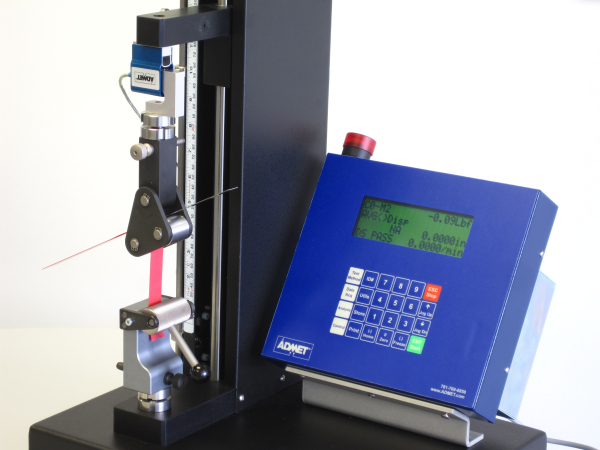
- Secure the specimen according to the diagram above.
- Pull sample at a constant rate of 250mm/minute until break.
- Plot load vs. displacement and record observation on reason for bond area failure. (ie; adhesive, substrate)
- The specification asks the user to set up the testing profile in a particular way. Using an ADMET Testing System and MTESTQuattro PC based servo control data acquisition, analysis, and reporting software the following profile can be established.
- Specimen geometry- bonded length 12.5cm.
- Specimen ID with auto increment for data file and results file names.
- Grip separation- 2.5cm
- Logging threshold set to 2.5cm displacement.
- Calculate Average Load between extension points- 2.5cm and 22.5cm
- Calculate T-Peel strength- Divide average load (n) by width of specimen (cm)
- Show statistical summary report(high, low, mean, st. dev, range,+-3 sigma) This report is found in a results file compiled of all specimens tested with this profile and meeting the substrate description defined earlier in sample preparation section.

For reference to ASTM D1876 blog post and testing video.
Recommended equipment

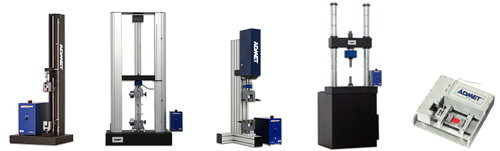
Single Column Universal Testing System or Dual Column Universal Testing System equipped with MTESTQuattro, load cell, vise grips and inserts.
Optional Bath fixture available from ADMET in many sizes for Tissue Samples that must remain in solution throughout the testing. Grips are specially coated to maintain integrity in solution.
Contact ADMET 1-800-667-3220 or info@ADMET.com for more information.
Click on these links for more information...
More Testing News
More Testing Videos
More Testing Specifications
Request a Quote
Ask an Engineer a question
ADMET 1-800-667-3220 www.ADMET.com
Posted by Debbi Cohen on Fri, Jun 18, 2010 @ 07:53 AM
ASTM F1264 Annex 3 is a test method for bending fatigue testing of intramedullary fixation devices (IMFD). This cyclic 4 point bend test determines the fatigue life at a specified bending moment or estimates the fatigue strength for a specified number of cycles.
1.) The four point bend fixture should be attached to a Universal Testing System and adjusted as follows;
- The suggested Short and Long Spans in A1.8.1 should be used whenever possible. The two spans listed below are common.
s=c=38mm (1.5in.) L=114mm(4.5in.)
s=c=76mm (3.0in.) L=228mm(9.0in.)
- Guides could be added to the outside edges of the bend fixture to prevent the IMFD from shifting position during testing. The guides must not interfere with load application or specimen deformation.
- If the IMFD is a unique shape or curved be careful to secure the specimen as directed in the full description of this specification. Link below.
IMFD Bone Plates 4-pt. bend fixture
2.) Before starting the multicycle test the load and the #of cycles the test will run, runout, must be determined. There are a few methods to use;
- Test IMFD at different load levels to failure and plot failure loads vs. number of cycles.
- Determine nominal stress through moment analysis using analytical or experimental methods.
- Fatigue Strength Determination- 1 million cycle test to determine maximum moment applied to the IMFD to cause failure.
Using
MTESTQuattro, our PC based control system, it is easy to create a variety of testing profiles. This profile is a compression test repeating for multiple cycles.
ASTM F1264-A3 requires you to;
- create a sinusoid cyclic curve at a rate of <=5Hz.
- Record number of cycles as the test is progressing.
- Set limits that will tell the testing system to stop the test when the specimen fails or deviates from intended load.
Recommended system
Click on these links for more information...
More Testing News
More Testing Videos
More Testing Specifications
Request a Quote
Ask an Engineer a question
ADMET 1-800-667-3220 www.ADMET.com
Posted by Debbi Cohen on Thu, Apr 08, 2010 @ 10:17 AM
ASTM F88-94 Package Peel Tensile Strength is summarized below. This specification is focused on the force required to pull open a seam of a package. It is vital to protect the contents of a package, especially when the package contains sterilized medical instruments or a medical device. Conditions can effect the the type of package and the type of seal that could be used for a package design. The type description of a package seal being tested needs to be clearly defined. ADMET's PC Based, MTESTQuattro controller allows up to 10 user definable fields to describe the specimen. It is imperative when the evaluator compares different types of packaging seals, they know exactly how each is defined.
Samples must conform to ASTM D882 and conditioned according to ASTM D685. This defines how the samples must be prepared for testing.
In our example video below, we prepared 1 inch by 3 inch samples. We set the sample in the grip and centered the sealed region in between the two grips. Our test was a 180 degree peel.
It is possible to set up at 180 degree pull using a rigid alignment plate held in one grip and the flexible tail held in the movable top grip. Also, if you are testing a packaging tray, you would secure the tray on the bottom rigid alignment plate or on a sliding plate, and then pull the tray cover from a corner at 45 degrees or the top of the seal at 90 degrees.
We set the testing profile at 10 inches/minute until break.
- We recorded Max Force, % Elongation, Force-Extension relationship, and Energy.
.jpg)
.jpg)
Above- Examples of specimen set ups.
Below- Video example of a packaging seal strength test.

Above - MTESTQuattro screen with live XYplot, quick start menu, live indicators for up to 8 channels of input, workspace data organizer, and control panel.
For more testing news...
For more testing videos...
To ask an engineer a question, click here
ADMET 1-800-667-3220, sales@admet.com
Click on these links for more information...
More Testing News
More Testing Videos
More Testing Specifications
Request a Quote
Ask an Engineer a question
ADMET 1-800-667-3220 www.ADMET.com
Posted by Debbi Cohen on Mon, Mar 01, 2010 @ 02:47 PM
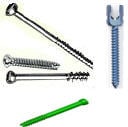
ASTM F543 Annex A2 is used to measure the torque required to drive a bone screw into a test block made of a rigid unicellular polyurethane foam. The results obtained from this test bear no direct correlation to the torque required to insert a bone screw in human or animal bone. This method is used as a quality control check for maintaining product uniformity.
The basic test procedure for determining the insertion and removal torque is as follows:
- Clamp the test block with a pre-drilled pilot hole into the machine.
- Drive the bone screw into the test block at a rate between 1 and 5 rpm. The insertion torque will be the maximum torque measured within the first four revolutions of the bone screw.
- Reverse direction and record the maximum removal torque during the four revolutions required to remove the bone screw.
Note: A 1.14 kg (2.5 lb) or less axial force should be applied to maintain engagement between the screw head and drive bit.
The embedded video demonstrates the ADMET E81 Torsion Tester recording the insertion and removal torque of a bone screw according to ASTM F543-A2. The test apparatus is a 20Nm capacity vertical torsion tester equipped with ADMET's MTESTQuattro® PC based Torsion Testing Software.
For more information on the ADMET Torsion Systems call 1-800-667-3220 or sales@ADMET.com or www.ADMET.com.
Click on these links for more information...
More Testing News
More Testing Videos
More Testing Specifications
Request a Quote
Ask an Engineer a question
ADMET 1-800-667-3220 www.ADMET.com
Posted by Debbi Cohen on Mon, Mar 01, 2010 @ 02:41 PM
ASTM F543 Annex A1 is used to determine the Torsional Properties of Metallic Bone Screws. The results obtained from this test bear no direct correlation to the torque required to insert a bone screw in human or animal bone. This method is used as a quality control check for maintaining product uniformity or to compare the mechanical properties of different, yet similarly sized, products.
Annex A1 is used to measure torsional yield strength, maximum torque and angle at break for metallic bone screws. A description of the ASTM F543-A1 test procedure is as follows:
- Clamp the specimen in a holding device so that five threads below the head of the screw are exposed. The clamping mechanism should prevent screw rotation. Refer to the ASTM specification if the screw is partially threaded or is too small.
- Drive the specimen at 1-5 rpm in the direction of insertion using an appropriate sized screwdriver bit by applying a torsional force until break. If an axial load is required to maintain the screwdriver bit in the screw head, its value should be recorded.
- Analysis: a) Torsional Offset Yield Strength is determined at 2 degrees offset using the torque versus angle of rotation curve. b) Maximum Torque is determined by the largest value on the torque versus angle of rotation curve. c) Breaking Angle is the point at which torque portion of the curve demonstrates its most rapid descent to total failure.
The embedded video demonstrates the use of an ADMET 81T Vertical Torsion Tester for determining offset yield torque, maximum torque and angle at break according to ASTM F543-A1. The torsion test apparatus is rated for 20Nm and is equipped with ADMET's MTESTQuattro® PC based Torsion Testing Software.
For more information on ADMET's Torsion Systems, contact sales@admet.com or 1-800-667-3220.
Click on these links for more information...
More Testing News
More Testing Videos
More Testing Specifications
Request a Quote
Ask an Engineer a question
ADMET 1-800-667-3220 www.ADMET.com
Posted by Debbi Cohen on Mon, Mar 01, 2010 @ 02:34 PM
Spinal Implants are tested according to several ASTM standards. ASTM F1717 is intended to provide a basis for the mechanical comparison among past, present and future spinal implant assemblies. Three static and one fatigue mechanical test of a spinal construct are governed by ASTM F1717. The three static tests are compression bending, tension bending and torsion. The fatigue test is a compression bending fatigue test. The mechanical tests are conducted in vitro using simplified loading schemes and do not attempt to mimic the complex loads of the spine. An outline of the four test procedures is as follows:
Static Compression Bend Test - Load at a crosshead displacement rate not to exceed 25 mm/min and record the load vs displacement curve. Calculate displacement at 2% offset yield, elastic displacement, compressive bending yield load, compressive bending stiffness, compressive bending ultimate displacement and ultimate load.
Static Tension Bend Test - Load at a crosshead displacement rate not to exceed 25 mm/min. and record the load vs displacement curve. Calculate displacement at 2% offset yield, elastic displacement, tensile bending yield load, tensile bending stiffness, tensile bending ultimate displacement and ultimate load.
Static Torsion Test - Load at a rate not to exceed 60 deg/min and record the torque vs angle curve. Calculate angle at 2% offset yield, elastic angle, yield torque and torsional stiffness.
Compressive Bending Fatigue Test - Apply a constant load amplitude sinusoidal control profile at no faster than 5Hz. A constant load ratio, R, for all tests should be established and should be greater than or equal to 10. Evaluate two specimens at the initial fatigue loads. Determine the maximum run out load based on no samples failing prior to 5 million cycles. Continue fatigue testing pairs of specimens until the difference between the load at which a specimen fails and the run out load is no greater than 10% of the compression bending ultimate load.
ADMET biaxial universal testing systems are available for static only or for both the static and fatigue tests outlined above. These tests require specific fixturing described in the F1717 specification and can be provide by ADMET.
ADMET eXpert 2610 5kN - 10Nm -Biaxial Tension, Compression, and Torsion Testing System equipped with the MTESTQuattro controller for static tests. System is shown with a multi axis load cell capable of measuring Fx, Fy, Fz and Mz.
Contact ADMET 1-800-667-0850, or email sales@ADMET.com
Click on these links for more information...
More Testing News
More Testing Videos
More Testing Specifications
Request a Quote
Ask an Engineer a question
ADMET 1-800-667-3220 www.ADMET.com
Posted by Debbi Cohen on Mon, Mar 01, 2010 @ 02:23 PM
Metallic Bone Plates need to undergo several tests before gaining approval as internal fixation devices of the skeletal system. One standard, ASTM F382-99, defines the test methods for single cycle bend testing (annex A1) and for determining the bending fatigue properties (annex A2) of metallic bone plates. A summary of the test methods for annex A1 and A2 follows. For a complete description of ASTM F382-99, refer to the specification from the ASTM International organization.
Annex A1- ASTM F382-A1 measures the bending stiffness, bending structural stiffness, and bending strength from a single cycle bend test on a metallic bone plate.
Annex A1 is used to determine values for the mechanical response of bone plates to specific bending loads and provides some insight into the mechanical response of the subject bone plate. The bone plate is positioned on a 4 point bend fixture (shown below) installed in an Universal Testing Machine (UTM). The bend fixture should use cylindrical rollers with diameters between 6-12 mm. The recommended test configuration locates the loading rollers at one third points. The spacing of the rollers, however, is dependent on the location of the screw holes in the bone plate. Apply bending moments of increasing magnitude via crosshead position rate control. Generate a load versus load point displacement graph. Determine the bending stiffness, bending structural stiffness and bending strength.

4 point bend fixture
eXpert 7601 eXpert 2611
To perform Annex 1, the 4 point bend fixture above can be used on an ADMET eXpert Single or Dual Column Universal Testing Machine Frame. ADMET has 2 types of controllers to set the speed, load, and position limits of the test. (MTESTQuattro and eP digital push button)
Annex A2 - Test Method for determining the bending fatigue properties of metallic bone plates.
This test method is used to determine the fatigue life at a specific or over a range of bending moment levels. It may also be used to estimate the fatigue strength for a specific number of cycles. The bone plate is positioned in a 4 point bend fixture so that a bone plate's section that would normally bridge the fracture site is subjected to a uniform bending moment. The bone plate is subjected to a constant amplitude constant frequency sinusoidal bending moment which is continued until the specimen fails or the runout cycle count is reached. The data generated from each plate test is used to create a M-N diagram (Bending Moment vs Number of Cycles). Typical cyclic frequencies and runout counts are 5 Hz and 1 million cycles, respectively.
Another Intermedullary Fixation Device standards, ASTM F1264, requires a static and fatigue 4 point bend test, as well as a static torsion test. Also, bone screws are subject to standard torsion testing. (ASTM F543 and ASTM F115)
1-800-667-3220 ADMET, Inc. call or email sales@ADMET.com any questions.
Click on these links for more information...
More Testing News
More Testing Videos
More Testing Specifications
Request a Quote
Ask an Engineer a question
ADMET 1-800-667-3220 www.ADMET.com
Posted by Andrew DeWolfe on Tue, Feb 23, 2010 @ 10:19 AM
ASTM D412 (D 412) covers the tensile properties of thermoset rubbers and thermoplastic elastomers. The specification describes two test methods, A and B. Method A is common and can be performed on a universal testing machine (tensile testing machine). If you are going to perform this test, you should read the entire specification from ASTM. This is a quick summary to decide if this test is right for you, and to point out what equipment you need to perform the test.
Test Procedure:
1. Cut or injection mold your material into a "dumbbell" shaped specimen.

2. Load the specimen into tensile grips.
3. Attach the optional extensometer to the sample
4. Begin the test by separating the tensile grips at a speed of 20 inches per minute
5. End the test after sample break (rupture)
Analysis obtained:
1. Stress at user-specified extension or elongation
2. Tensile Yield Stress
3. Tensile Yield Strain
4. Tensile Strength at Rupture
5. Elongation at Rupture
Equipment required:
1. Universal testing machine (tensile testing machine) with these minimum specifications:
A. Servo-controlled to keep a constant rate of speed during the test (+/- 2 inches/min)
B. At least 30 inches of crosshead travel or more for high elongation materials
C. Most small and common 1kN (225 pound) load capacity machines will work for the loads of the materials tested to this specification
All of our eXpert 2600 series dual column machines meet these requirements, and it is also common to use our single column eXpert 7601 XL with 53 inches of crosshead travel.
2. An extensometer is optional but recommended. We recommend one for two reasons. First, dumbbell specimens do not have uniform widths which cause errors when both the wide and narrow sections of the dumbbell shaped specimen elongate at different rates. Secondly, elongation is usually an important design characteristic of rubbers and elastomers so an extensometer can be used to improve accuracy of the measurement.
3. Software or suitable electronics are required to operate the machine and to take the measurements. Basic systems will provide the raw data, and stress-strain charts. Using these sources of data, you can determine and calculate all of the analysis listed above. However, fully PC based systems have the capability to calculate all of these automatically. For example, our MTESTQuattro testing software has built in support for ASTM D412 and all of these calculations are provided immediately after performing the test.
4. Tensile grips hold your specimen during the test as it is being
pulled apart. Quite often, hard specimens are difficult to hold properly as premature breakage and slippage can be common. However, rubbers and elastomers usually lend themselves to being easily held in a variety of grip designs such as manual vise grips, pneumatic grips, wedge grips, or eccentric roller designs. The most common and easy to use grips are manual vise or pneumatic grips with rubber coated or serrated insert faces.
This is the original article, a new version has been posted here.
Click on these links for more information...
More Testing News
More Testing Videos
More Testing Specifications
Request a Quote
Ask an Engineer a question
ADMET 1-800-667-3220 www.ADMET.com