Posted by Richard Gedney on Fri, Jul 16, 2010 @ 09:45 AM
In the ASTM acceptance standard for testing rubber surgical gloves (D3577) and rubber medical gloves (D3578), made of latex, vinyl, and nitrile. The standard describes the standard size, material properties, physical and mechanical property acceptance levels, aqueous protein and antigen protein content, and visual inspection required for a glove to be used in a medical procedure. Other relevant standards include ASTM D6319, ASTM D5250, EN 455-2, ISO 11193-1:2002, and ISO/AWI 11193-2.

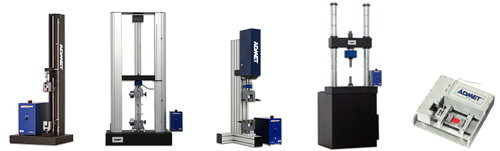
ADMET Single Column Testing and Dual Column Testing Systems can be used to test the physical and mechanical properties of the gloves.
Summary:
Classification
Type 1 - Gloves compounded primarily from natural rubber latex.
Type 2 - Gloves compounded from a rubber cement or from synthetic rubber latex
Sampling reference- ISO2859 and Table 1-ASTM D3577 full spec.
Referee Tests;
- Sterility Test
- Freedom from Holes
- Physical Dimensions Test
- Precision and Bias
- Physical Requirements Test
- Gloves will be tested according to ASTM D412.(Testing video)
- The Gloves are then put in heating chambers and undergo Accelerated Aging according to ASTM D573. (One can follow option a or b)
a)70 +-2 degrees Celsius for 22+-0.3 hours.
b)100+-2 degrees Celsius for 22+-0.3 hours.
After accelerated aging, the gloves must be tested to determine Tensile Strength and Elongation. The ideal limits are in the Table below.
| Type |
Tensile Strength |
Elongation |
500% Elongation |
|
Type 1 Before Aging
|
24 MPa, min |
750%, min |
5.5MPa, max |
|
Type 1 After Aging
|
18 MPa, min |
560%, min |
|
|
Type 2 Before Aging
|
17MPa, min |
650%, min |
7.0MPa, max |
|
Type 2 After Aging
|
12MPa, min |
490%, min |
|
- Precision and Bias are specified in ASTM D412.
- Powder Free Gloves residue determined by ASTM D6124.
- Aqueous Extractable Protein Content determined by ASTM D5712.
- Powdered Glove residue determined by ASTM D6124.
- Antigenic Protein Content determined by ASTM D6499.
- Dimensions and Tolerance Chart labeled Table 2 describes the length, width, and thickness sizes that are acceptable to this standard.
Equipment required:
1. Universal testing machine (tensile testing machine) with these minimum specifications: Single Column eXpert 7600 series, Dual Column eXpert 2600 series
A. Servo-controlled to keep a constant rate of speed during the test (+/- 2 inches/min)
B. At least 30 inches of crosshead travel or more for high elongation materials.
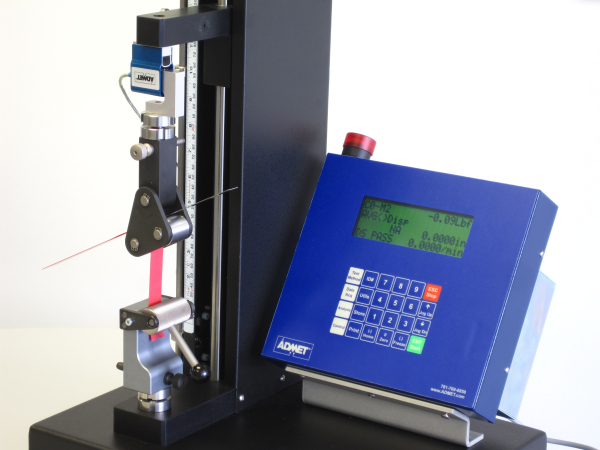
C. MTESTQuattro PC Based data acquisiton, data analysis, and reporting software. MTESTQuattro allows viewing real time XY plot, data report showing a description of the glove, tensile strength, elongation, and comments, as well as a statistical summary of multiple samples following the same test procedure.
D. Video or laser extensometers may be employed to increase the accuracy of the elongation calculations.
This is a summary of the standard. For a full, detailed description go to the ASTM website.

Click on these links for more information...
More Testing News
More Testing Videos
More Testing Specifications
Request a Quote
Ask an Engineer a question
ADMET 1-800-667-3220 www.ADMET.com
Posted by Andrew DeWolfe on Tue, Jul 13, 2010 @ 12:48 PM
Shear joints impose uniform stresses across the bond area which results in the highest possible joint strength. ASTM D1002 is commonly performed to measure the shear strength of adhesives that are used to bond metals. This test is similar to ASTM D3163 which is for adhesives that bond rigid plastic substrates, and also ASTM D3164 which is for plastic adhesives that are used to bond both plastic and metal substrates. All three of these
specifications use a single lap joint (lap shear) specimen to determine the shear strength of adhesives. If you are going to perform this test, you should read the entire specification from ASTM. This is a quick summary to decide if this test is right for you, and to point out what equipment you need to perform the test. Some of the content in this blog was taken from ADMET's shear testing article in Quality Magazine.
Test Procedure:
- Measure the amount of shear area in square inches or square centimeters.
- Load each end of the specimen in the tensile grips.
- Apply a force at a controlled rate to the specimen until it breaks and record the maximum force and type of joint failure.
- ASTM D1002 specifies a load control rate of 1,200 to 1,400 psi/minute. A cross head control rate of 0.05 inch/minute approximates the loading rate and also is an acceptable mode of control.
Test Report:
- Maximum force
- Maximum shear stress
- Divide the maximum force by the shear area and report
in units of kilogram/square centimeter or psi.
- Type of failure (separation from adhesive to substrate, separation through the adhesive, or both)
Equipment required:
- Universal testing machine (tensile testing machine) with these minimum specifications:
- Servo-controlled to keep a constant rate of speed during the test.
- Breaking load should be between 15 and 85% of machine capacity. This rule may be antiquated as there should be no trouble going to the full scale capacity of a machine. Many strong adhesives require a 10,000 pound (50kN) capacity testing machine (ADMET eXpert 2613). Most common is a 2,000 pound (10kN) testing machine (ADMET eXpert 2611).
- Software or suitable electronics are required to operate the machine, report peak load, and provide a force / displacement chart.

- Grips: Vise grips with serrated inserts are commonly used for lap shear tests. The serrated grip inserts are designed to dig into the material and prevent it from slipping. If slippage occurs with a vice grip, self-tightening grips of pneumatic or wedge design may be used. The grip inserts should be aligned so that the centerline of the grip assembly is aligned with the adhesive bond. Proper alignment is achieved with vice grips by adjusting the grip inserts from side to side so that the center line of the upper and lower grips pass through the adhesive.
Other common adhesive shear specifications:
ASTM D905 - Strength Properties of Adhesive Bonds in Shear by Compression Loading
ASTM D906 - Strength Properties of Adhesives in Plywood Type Construction in Shear
ASTM D1002 - Apparent Shear Strength of Single-Lap-Joint Adhesively Bonded Metal Specimens
ASTM D2293 - Creep Properties of Adhesives in Shear by Compression Loading
ASTM D2294 - Standard Guide for Use of Adhesive-Bonded Single Lap-Joint Specimen Test Results
ASTM D2295 - Strength Properties of Adhesives in Shear by Tension Loading at Elevated Temperatures
ASTM D2339 - Strength Properties of Adhesives in Two-Ply Wood Construction in Shear
ASTM D2557 - Tensile-Shear Strength of Adhesives in the Subzero Temperature Range from -267.8 to -55 C
ASTM D2919 - Determining Durability of Adhesive Joints Stressed in Shear by Tension Loading
ASTM D3163 - Determining Strength of Adhesively Bonded Rigid Plastic Lap-Shear Joints in Shear
ASTM D3164 - Strength Properties of Adhesively Bonded Plastic Lap-Shear Sandwich Joints in Shear
ASTM D3165 - Strength Properties of Adhesives in Shear Single-Lap-Joint Laminated Assemblies
ASTM D3166 - Fatigue Properties of Adhesives in Shear by Tension Loading (Metal/Metal)
ASTM D3528 - Strength Properties of Double Lap Shear Adhesive Joints by Tension Loading
ASTM D3931 - Determining Strength of Gap-Filling Adhesive Bonds in Shear by Compression
ASTM D4027 - Measuring Shear Properties of Structural Adhesives by the Modified-Rail Test
ASTM D4498 - Heat-Fail Temperature in Shear of Hot Melt Adhesives
ASTM D4501 - Shear Strength of Adhesive Bonds Between Rigid Substrates by the Block-Shear Method
ASTM D4562 - Shear Strength of Adhesives Using Pin-and-Collar Specimen
ASTM D5656 - Thick-Adhered Metal Lap-Shear Joints for the Stress-Strain Behavior
ASTM D5868 - Lap Shear Adhesion for Fiber Reinforced Plastic (FRP) Bonding
ASTM D6463 - Time to Failure of Pressure Sensitive Articles under Sustained Shear Loading
Click on these links for more information...
More Testing News
More Testing Videos
More Testing Specifications
Request a Quote
Ask an Engineer a question
ADMET 1-800-667-3220 www.ADMET.com
Posted by Andrew DeWolfe on Wed, Apr 28, 2010 @ 01:23 PM
The tear strength of thermoset rubbers, thermoplastic elastomers, and silicones can be measured according to specification ASTM D624. The test measures the strength required to initiate a tear in a material. D624 describes multiple different types of sample shapes that can be tested in a standard universal testing machine (tensile testing machine). Usually materials that are tested to D624 are also tested according to specification ASTM D412 to measure the tensile strength and elongation. If you are going to perform this test, you should read the entire specification from ASTM. This is a quick summary to decide if this test is right for you, and to point out what equipment you need to perform the test.
This video shows how to perform a tear strength test:
Test Procedure:
- Cut or injection mold your material into one of the tear shapes shown in the specification. Specimen B and C are the most common.
- Measure the width of the specimen
- Load the specimen into tensile grips.
- Begin the test by separating the tensile grips at a speed of 20 inches per minute
- End the test after sample break (rupture)
Analysis obtained:
- Tear Strength - lb/in unit. (Peak load observed during test / thickness of material)
Equipment required (same as ASTM D412 machines):
1. Universal testing machine (tensile testing machine) with these minimum specifications:
- Servo-controlled to keep a constant rate of speed during the test of at least 20in/min (+/- 2 inches/min)
- At least 30 inches of crosshead travel or more for high elongation materials
- Most small and common 1kN (225 pound) are fine for this test (see ADMET eXpert 7601).
2. Software or suitable electronics are required to operate the machine and to take the measurements. Basic systems will provide the raw data, and stress-strain charts. Using these sources of data, you can calculate tear strength yourself (peak load / material thickness). However, fully PC based systems have the capability to calculate all of these automatically such as our MTESTQuattro testing software which has built in support for ASTM D624. Using this system would provide you with the tear strength immediately after performing the test.
3. Tensile grips hold your specimen during the test as it is being pulled apart. Rubbers and elastomers usually lend themselves to being easily held in a variety of grip designs such as manual vise grips, pneumatic grips, wedge grips, or eccentric roller designs.
Click here if you are also interested in ASTM D412 tensile strength and elongation testing.
ASTM D624 Die C Specimen in Tensile Grips

ADMET eXpert 7601 Single Column Testing Machine
Click on these links for more information...
More Testing News
More Testing Videos
More Testing Specifications
Request a Quote
Ask an Engineer a question
ADMET 1-800-667-3220 www.ADMET.com
Posted by Andrew DeWolfe on Fri, Apr 23, 2010 @ 07:37 AM
This article discusses how to perform a polyurethane foam tear strength test on a universal testing machine (polyolefin foams are tested similarly). Complete instructions for a foam tear strength test can be found in ASTM D3574 Test F which applies to slab, bonded, and molded flexible cellular urethane foams. There are many tests in this specification including tests for density, ball rebound, airflow, etc. However, the most common tests in the specification are the mechanical tests that can be performed on a universal testing machine such as indentation force deflection, compression force deflection and tensile strength. This article discusses Test F, the foam tear resistance test.
The purpose of performing the tear test on polyurethane foam is to measure the peak force during a foam tear. This provides a measure of the material's resistance to tearing. The specification does not call for this, but it is common to measure the average load across an extension range. The average calculation is built into our testing systems, all you need to do is specify two displacement points that you want to average between. For example, if you tear your sample four inches, you may want to average the load from 1" to 3" to eliminate the starting or ending forces that may not be consistent with the normal tear strength.
The foam tear strength test is similar to testing other polymers, but due to the thickness, gripping the foam is sometimes a challenge. The specimen is usually 1" wide by 1" thick with 1/2" of the split sample being held by each grip. Foams do not typically have high tear strengths, so low force (1kN) capacity grips are fine. Therefore the most commonly used grips are wide opening (at least 20mm) 1kN capacity vise or pneumatic grips.
With the right equipment and test procedure, the test is actually quite easy. A video of a foam tear strength test is shown here:
We have a lot of information on polyurethane foam testing according to ASTM D3574. Click the links below to learn more:
1. General Equipment requirements for ASTM D3574
2. Indentation Force Deflection Test (IFD)
3. Tensile Strength
Click here if you would like to ask an engineer a question, or click here if you would like a quote on a system.

ASTM D3574 tear strength test report from ADMET's MTESTQuattro software

ASTM D3574 tear strength test setup on an ADMET eXpert 7601
ASTM D3574 tear strength sample
Click on these links for more information...
More Testing News
More Testing Videos
More Testing Specifications
Request a Quote
Ask an Engineer a question
ADMET 1-800-667-3220 www.ADMET.com
Posted by Andrew DeWolfe on Thu, Apr 22, 2010 @ 09:40 AM
This article discusses foam tensile strength testing. A foam tensile strength test can be found in ASTM D3574 Test E which applies to slab, bonded, and molded flexible cellular urethane foams. There are many tests in this specification including tests for density, ball rebound, airflow, etc. However, the most common tests in the specification are the mechanical tests that can be performed on a universal testing machine such as
indentation force deflection, compression force deflection and tear resistance. This article discusses Test E, the foam tension test.
The purpose of performing the tension test on polyurethane foam is to measure the tensile strength and elongation. The tensile strength is obtained by simply dividing the peak load observed during the test by the cross-sectional area of the sample.
The foam tensile strength test is similar to testing other polymers, but gripping and measuring extension require a bit more care. The minimum foam thickness during testing is 12.5mm and it is common to measure thicker samples. Foams do not typically have high tensile strengths, so low force (1kN) capacity grips are fine. Therefore the best grips to use are wide opening (at least 20mm) 1kN capacity vise or pneumatic grips.
Measuring extension is tricky. Because the sample is "dogbone" shaped, using grip separation to measure elongation is less than ideal due to the error caused by the non-uniform specimen width. Despite this, it is still common to measure elongation using grip separation. The reason for this is because contact extensometers clip on the foam and this distorts the sample thickness and causes premature sample breakage. Non contact optical extensometers work well but the high cost (often times more expensive than the rest of the testing machine) makes them unpractical.
With the right equipment, the test is actually quite easy. A video of a foam tensile strength test is shown here:
We have a lot of information on polyurethane foam testing according to ASTM D3574. Click the links below to learn more:
1. General Equipment requirements for ASTM D3574
2. Indentation Force Deflection Test (IFD)
3. Tear Strength
Click here if you would like to ask an engineer a question, or click here if you would like a quote on a system.

Notice how the extensometer distorts the foam too much

Foam "dogbone" shape specimen

Tensile test setup
Test report from MTESTQuattro software
Click on these links for more information...
More Testing News
More Testing Videos
More Testing Specifications
Request a Quote
Ask an Engineer a question
ADMET 1-800-667-3220 www.ADMET.com
Posted by Debbi Cohen on Thu, Apr 08, 2010 @ 10:17 AM
ASTM F88-94 Package Peel Tensile Strength is summarized below. This specification is focused on the force required to pull open a seam of a package. It is vital to protect the contents of a package, especially when the package contains sterilized medical instruments or a medical device. Conditions can effect the the type of package and the type of seal that could be used for a package design. The type description of a package seal being tested needs to be clearly defined. ADMET's PC Based, MTESTQuattro controller allows up to 10 user definable fields to describe the specimen. It is imperative when the evaluator compares different types of packaging seals, they know exactly how each is defined.
Samples must conform to ASTM D882 and conditioned according to ASTM D685. This defines how the samples must be prepared for testing.
In our example video below, we prepared 1 inch by 3 inch samples. We set the sample in the grip and centered the sealed region in between the two grips. Our test was a 180 degree peel.
It is possible to set up at 180 degree pull using a rigid alignment plate held in one grip and the flexible tail held in the movable top grip. Also, if you are testing a packaging tray, you would secure the tray on the bottom rigid alignment plate or on a sliding plate, and then pull the tray cover from a corner at 45 degrees or the top of the seal at 90 degrees.
We set the testing profile at 10 inches/minute until break.
- We recorded Max Force, % Elongation, Force-Extension relationship, and Energy.
.jpg)
.jpg)
Above- Examples of specimen set ups.
Below- Video example of a packaging seal strength test.

Above - MTESTQuattro screen with live XYplot, quick start menu, live indicators for up to 8 channels of input, workspace data organizer, and control panel.
For more testing news...
For more testing videos...
To ask an engineer a question, click here
ADMET 1-800-667-3220, sales@admet.com
Click on these links for more information...
More Testing News
More Testing Videos
More Testing Specifications
Request a Quote
Ask an Engineer a question
ADMET 1-800-667-3220 www.ADMET.com
Posted by Andrew DeWolfe on Mon, Mar 15, 2010 @ 03:38 PM
ASTM D1414 (D 1414) covers multiple properties of O-Rings. Part of the specification includes tension testing for determining the breaking force, tensile strength, and ultimate elongation of an o-ring. The tension test is intended to be performed on a universal testing machine (tensile testing machine). If you are going to perform this test, you should read the entire specification from ASTM. This is a quick summary to decide if this test is right for you, and to point out what equipment you need to perform the test.
Here is a short video of the test:
Test Procedure:
1. Lubricate the grip spools with oil (not required if doing step # 4)
2. Load the o-ring on both the upper and lower spools
3. Begin the test by separating the grips at a speed of 20 inches per minute
4. Rotate one spool one revolution per six inches of travel (not required if doing step # 1)
5. End the test after sample break (rupture)
Analysis obtained:
1. Breaking Force
2. Tensile Strength
3. Ultimate Elongation
Equipment required:
1. Universal testing machine (tensile testing machine) with these minimum specifications: (similar to those in ASTM D412)
A. Servo-controlled to keep a constant rate of speed during the test (+/- 2 inches/min)
B. At least 30 inches of crosshead travel or more for high elongation materials
C. Most small and common 1kN (225 pound) load capacity machines will work for the loads of the materials tested to this specification
D. All of our eXpert 2600 series dual column machines meet these requirements, and it is also common to use our single column eXpert 7601 XL with 53 inches of crosshead travel.
2. ASTM D1414 requires special grips. These grips have interchangeable spools with various diameters for a wide variety of o-rings. The spools rotate freely on a pin extending from the grip. If using the motorized version, the bottom grip and spool is connected to a small variable speed electric motor to enable rotation during the test to minimize stresses. Other more primitive and costly systems have been employed that generate rotation from the upward movement of the crosshead. However, the optional motorized version is easier to use and is usually less expensive.

ADMET Motorized ASTM D1414 O-Ring Fixture
3. If you don't want to use the motorized fixture, the specification allows you to lubricate the spools instead. In this case, you would just use two of the upper grips.
Click on these links for more information...
More Testing News
More Testing Videos
More Testing Specifications
Request a Quote
Ask an Engineer a question
ADMET 1-800-667-3220 www.ADMET.com
Posted by Andrew DeWolfe on Tue, Feb 23, 2010 @ 10:19 AM
ASTM D412 (D 412) covers the tensile properties of thermoset rubbers and thermoplastic elastomers. The specification describes two test methods, A and B. Method A is common and can be performed on a universal testing machine (tensile testing machine). If you are going to perform this test, you should read the entire specification from ASTM. This is a quick summary to decide if this test is right for you, and to point out what equipment you need to perform the test.
Test Procedure:
1. Cut or injection mold your material into a "dumbbell" shaped specimen.

2. Load the specimen into tensile grips.
3. Attach the optional extensometer to the sample
4. Begin the test by separating the tensile grips at a speed of 20 inches per minute
5. End the test after sample break (rupture)
Analysis obtained:
1. Stress at user-specified extension or elongation
2. Tensile Yield Stress
3. Tensile Yield Strain
4. Tensile Strength at Rupture
5. Elongation at Rupture
Equipment required:
1. Universal testing machine (tensile testing machine) with these minimum specifications:
A. Servo-controlled to keep a constant rate of speed during the test (+/- 2 inches/min)
B. At least 30 inches of crosshead travel or more for high elongation materials
C. Most small and common 1kN (225 pound) load capacity machines will work for the loads of the materials tested to this specification
All of our eXpert 2600 series dual column machines meet these requirements, and it is also common to use our single column eXpert 7601 XL with 53 inches of crosshead travel.
2. An extensometer is optional but recommended. We recommend one for two reasons. First, dumbbell specimens do not have uniform widths which cause errors when both the wide and narrow sections of the dumbbell shaped specimen elongate at different rates. Secondly, elongation is usually an important design characteristic of rubbers and elastomers so an extensometer can be used to improve accuracy of the measurement.
3. Software or suitable electronics are required to operate the machine and to take the measurements. Basic systems will provide the raw data, and stress-strain charts. Using these sources of data, you can determine and calculate all of the analysis listed above. However, fully PC based systems have the capability to calculate all of these automatically. For example, our MTESTQuattro testing software has built in support for ASTM D412 and all of these calculations are provided immediately after performing the test.
4. Tensile grips hold your specimen during the test as it is being
pulled apart. Quite often, hard specimens are difficult to hold properly as premature breakage and slippage can be common. However, rubbers and elastomers usually lend themselves to being easily held in a variety of grip designs such as manual vise grips, pneumatic grips, wedge grips, or eccentric roller designs. The most common and easy to use grips are manual vise or pneumatic grips with rubber coated or serrated insert faces.
This is the original article, a new version has been posted here.
Click on these links for more information...
More Testing News
More Testing Videos
More Testing Specifications
Request a Quote
Ask an Engineer a question
ADMET 1-800-667-3220 www.ADMET.com
Posted by Andrew DeWolfe on Fri, Feb 12, 2010 @ 08:16 AM
To determine the breaking strength, elongation, etc. of threads, yarns, or other single strand textiles, ASTM D2256 (D 2256) is by far the most common specification that is followed. This is a relatively simple tensile test whereby thread is pulled at a constant rate of speed until it breaks. Please see the video below that shows how the test is performed:
Test Procedure:
- Load thread into pneumatic or manual rope grips
- Gage length (length of thread between grips) should be 10"
- One grip should pull the thread at a servo controlled constant rate of 12" per minute.
Common measurements obtained:
- Breaking Force (Maximum force)
- Breaking Tenacity
- B=F/T
- B = Breaking Tenacity
- F = Breaking Force
- T = Linear Density in units of tex or denier
- Elongation
- Initial Modulus
- Chord Modulus (Suggested elongation are 0% and 10%)
- Breaking Toughness (Energy)

Required Equipment:
- Servo controlled constant rate of extension (CRE) tensile testing machine (if you have an ADMET machine, don't worry, all ADMET machines are servo controlled and can do CRE testing)
- Pneumatic or manual rope grips where the thread is wrapped around a mandrel (circular feature) or a "horn" shape and is then pinched in the grips. This prevents premature thread breakage.
- Software that can automatically calculate all measurements (we use our MTESTQuattro software).
Tips:
- Make sure your data acquisition is set high because the test is short as thread breakage happens quickly. We set our machines to 1,000 Hz to take 1,000 load and position measurements every second.
- Make sure your thread is lined up evenly between the top and bottom grip. Slight errors in alignment can significantly alter the repeatability. By design, our "V" shaped channel pneumatic grips prevent misalignment.
ADMET "Horn" style pneumatic thread / rope grip with "V" channel alignment feature.
Click on these links for more information...
More Testing News
More Testing Videos
More Testing Specifications
Request a Quote
Ask an Engineer a question
ADMET 1-800-667-3220 www.ADMET.com
Posted by Andrew DeWolfe on Fri, Jan 08, 2010 @ 08:42 AM
One of the most common specifications that our customers follow is ASTM D882 which is the Standard Test Method for Tensile Properties of Thin Plastic Sheeting. This test is very similar to the common ASTM D638 test whereby plastic material is pulled until in breaks in order to measure elongation, tensile modulus, tensile yield strength, and tensile strength at break. However, it is designed specifically for thin sheeting and film less than 1 mm (0.04") thick.
The nice part about ASTM D882 is that the specimens are rectangular strips of film and are not "dumbbell" or "dog bone" shaped. The flat geometry of the specimens and the typical characteristic of films having high elongation allow most users to avoid using an extensometer which allows them to reduce the cost of the testing system and simplifies their testing regimen.
The two main things to keep in mind in regards to equipment are the height of the testing machine and having grips designed to hold the thin film correctly. We always recommend our eXpert 7601single column test machine with 29" of crosshead travel for films with less than 300% elongation and our 53" model for really high elongation films that elongate up to 900%. The grips we recommend are pneumatic vise grips with rubber coated inserts. The rubber coated inserts help to keep the film from prematurely breaking at the grip edge, and in combination with the constant pneumatic pressure the film is prevented from slipping out of the grips during the test. We use foot pedals to allow the operator to open and close the grips with their feet because thin films usually require both hands to line everything up properly. If you have a 30" crosshead travel machine, the grips and load cell will take up about 12" of that travel. If you use a 4" gage length it will take up another 4" of the travel. This leaves 14" of testing travel which will be fine for materials with less than 350% elongation (14" crosshead travel / 4" original gage length = 3.5 * 100% = 350%) A 54" crosshead travel machine is better suited for materials that have elongation up to 950%.
We are always available to answer your questions. Should you have any questions, please feel free to call us @ 800-667-3220 or visit our website for more information.
eXpert 7601 Pneumatic Vise Grip Foot Pedal
Click on these links for more information...
More Testing News
More Testing Videos
More Testing Specifications
Request a Quote
Ask an Engineer a question
ADMET 1-800-667-3220 www.ADMET.com