Posted by Andrew DeWolfe on Fri, Jun 04, 2010 @ 08:06 AM
One method to measure the tack force / strength of an adhesive is to perform the "Loop Tack" test method described in specification ASTM D6195. The adhesives tested with this test are typically pressure sensitive adhesives (PSA) applied to films, labels, tapes, and stickers where the initial tack force is an important characteristic of the product. The specification describes two ways to perform the test. One method (Method B) uses a single purpose machine. Although the simplicity of one dedicated machine is nice, the loop tack method is uncommonly the sole test of any manufacturer. The other method (Method A) uses a universal testing machine otherwise known as a tensile testing machine. Using this method provides you with accurate test results, the same ease of use as the single purpose machine, and also allows you to use the universal testing machine for many other common adhesive and material tests such as 90 degree peel adhesion tests, 180 degree peel adhesion tests, and standard tensile strength testing. If you only need to perform the loop tack test you should consider a single purpose machine and follow Method B. If you have a tensile testing machine, or need to perform other adhesive and material tests, you should follow Method A.
This is a short video of the test followed by a simple summary to help determine if this test is right for your application. Please read the entire ASTM specification if you decide to perform the test.
Procedure:
1. Make a loop with your tape with the adhesive on the outside of the loop.
2. Place the loop in the top grip of the universal testing machine.
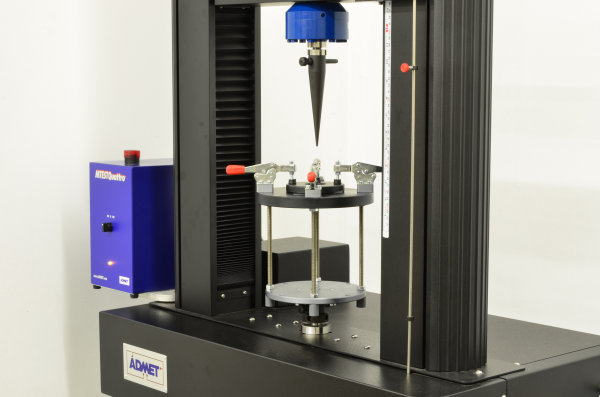
3. Bring the loop into contact with a 1" cube fastened to the bottom of the universal testing machine.
4. Remove the tape from the 1" cube fixture.
5. Report the peak and/or the average force during removal.

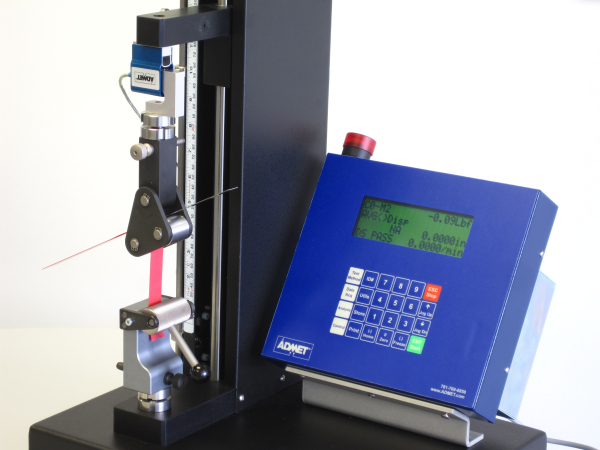
Test performed on an ADMET eXpert 7601 universal testing machine.

Test report generated from ADMET's MTESTQuattro testing software.
Click on these links for more information...
More Testing News
More Testing Videos
More Testing Specifications
Request a Quote
Ask an Engineer a question
ADMET 1-800-667-3220 www.ADMET.com
Posted by Andrew DeWolfe on Wed, Apr 28, 2010 @ 01:23 PM
The tear strength of thermoset rubbers, thermoplastic elastomers, and silicones can be measured according to specification ASTM D624. The test measures the strength required to initiate a tear in a material. D624 describes multiple different types of sample shapes that can be tested in a standard universal testing machine (tensile testing machine). Usually materials that are tested to D624 are also tested according to specification ASTM D412 to measure the tensile strength and elongation. If you are going to perform this test, you should read the entire specification from ASTM. This is a quick summary to decide if this test is right for you, and to point out what equipment you need to perform the test.
This video shows how to perform a tear strength test:
Test Procedure:
- Cut or injection mold your material into one of the tear shapes shown in the specification. Specimen B and C are the most common.
- Measure the width of the specimen
- Load the specimen into tensile grips.
- Begin the test by separating the tensile grips at a speed of 20 inches per minute
- End the test after sample break (rupture)
Analysis obtained:
- Tear Strength - lb/in unit. (Peak load observed during test / thickness of material)
Equipment required (same as ASTM D412 machines):
1. Universal testing machine (tensile testing machine) with these minimum specifications:
- Servo-controlled to keep a constant rate of speed during the test of at least 20in/min (+/- 2 inches/min)
- At least 30 inches of crosshead travel or more for high elongation materials
- Most small and common 1kN (225 pound) are fine for this test (see ADMET eXpert 7601).
2. Software or suitable electronics are required to operate the machine and to take the measurements. Basic systems will provide the raw data, and stress-strain charts. Using these sources of data, you can calculate tear strength yourself (peak load / material thickness). However, fully PC based systems have the capability to calculate all of these automatically such as our MTESTQuattro testing software which has built in support for ASTM D624. Using this system would provide you with the tear strength immediately after performing the test.
3. Tensile grips hold your specimen during the test as it is being pulled apart. Rubbers and elastomers usually lend themselves to being easily held in a variety of grip designs such as manual vise grips, pneumatic grips, wedge grips, or eccentric roller designs.
Click here if you are also interested in ASTM D412 tensile strength and elongation testing.
ASTM D624 Die C Specimen in Tensile Grips

ADMET eXpert 7601 Single Column Testing Machine
Click on these links for more information...
More Testing News
More Testing Videos
More Testing Specifications
Request a Quote
Ask an Engineer a question
ADMET 1-800-667-3220 www.ADMET.com
Posted by Andrew DeWolfe on Tue, Feb 23, 2010 @ 10:19 AM
ASTM D412 (D 412) covers the tensile properties of thermoset rubbers and thermoplastic elastomers. The specification describes two test methods, A and B. Method A is common and can be performed on a universal testing machine (tensile testing machine). If you are going to perform this test, you should read the entire specification from ASTM. This is a quick summary to decide if this test is right for you, and to point out what equipment you need to perform the test.
Test Procedure:
1. Cut or injection mold your material into a "dumbbell" shaped specimen.

2. Load the specimen into tensile grips.
3. Attach the optional extensometer to the sample
4. Begin the test by separating the tensile grips at a speed of 20 inches per minute
5. End the test after sample break (rupture)
Analysis obtained:
1. Stress at user-specified extension or elongation
2. Tensile Yield Stress
3. Tensile Yield Strain
4. Tensile Strength at Rupture
5. Elongation at Rupture
Equipment required:
1. Universal testing machine (tensile testing machine) with these minimum specifications:
A. Servo-controlled to keep a constant rate of speed during the test (+/- 2 inches/min)
B. At least 30 inches of crosshead travel or more for high elongation materials
C. Most small and common 1kN (225 pound) load capacity machines will work for the loads of the materials tested to this specification
All of our eXpert 2600 series dual column machines meet these requirements, and it is also common to use our single column eXpert 7601 XL with 53 inches of crosshead travel.
2. An extensometer is optional but recommended. We recommend one for two reasons. First, dumbbell specimens do not have uniform widths which cause errors when both the wide and narrow sections of the dumbbell shaped specimen elongate at different rates. Secondly, elongation is usually an important design characteristic of rubbers and elastomers so an extensometer can be used to improve accuracy of the measurement.
3. Software or suitable electronics are required to operate the machine and to take the measurements. Basic systems will provide the raw data, and stress-strain charts. Using these sources of data, you can determine and calculate all of the analysis listed above. However, fully PC based systems have the capability to calculate all of these automatically. For example, our MTESTQuattro testing software has built in support for ASTM D412 and all of these calculations are provided immediately after performing the test.
4. Tensile grips hold your specimen during the test as it is being
pulled apart. Quite often, hard specimens are difficult to hold properly as premature breakage and slippage can be common. However, rubbers and elastomers usually lend themselves to being easily held in a variety of grip designs such as manual vise grips, pneumatic grips, wedge grips, or eccentric roller designs. The most common and easy to use grips are manual vise or pneumatic grips with rubber coated or serrated insert faces.
This is the original article, a new version has been posted here.
Click on these links for more information...
More Testing News
More Testing Videos
More Testing Specifications
Request a Quote
Ask an Engineer a question
ADMET 1-800-667-3220 www.ADMET.com
Posted by Andrew DeWolfe on Fri, Jan 08, 2010 @ 08:42 AM
One of the most common specifications that our customers follow is ASTM D882 which is the Standard Test Method for Tensile Properties of Thin Plastic Sheeting. This test is very similar to the common ASTM D638 test whereby plastic material is pulled until in breaks in order to measure elongation, tensile modulus, tensile yield strength, and tensile strength at break. However, it is designed specifically for thin sheeting and film less than 1 mm (0.04") thick.
The nice part about ASTM D882 is that the specimens are rectangular strips of film and are not "dumbbell" or "dog bone" shaped. The flat geometry of the specimens and the typical characteristic of films having high elongation allow most users to avoid using an extensometer which allows them to reduce the cost of the testing system and simplifies their testing regimen.
The two main things to keep in mind in regards to equipment are the height of the testing machine and having grips designed to hold the thin film correctly. We always recommend our eXpert 7601single column test machine with 29" of crosshead travel for films with less than 300% elongation and our 53" model for really high elongation films that elongate up to 900%. The grips we recommend are pneumatic vise grips with rubber coated inserts. The rubber coated inserts help to keep the film from prematurely breaking at the grip edge, and in combination with the constant pneumatic pressure the film is prevented from slipping out of the grips during the test. We use foot pedals to allow the operator to open and close the grips with their feet because thin films usually require both hands to line everything up properly. If you have a 30" crosshead travel machine, the grips and load cell will take up about 12" of that travel. If you use a 4" gage length it will take up another 4" of the travel. This leaves 14" of testing travel which will be fine for materials with less than 350% elongation (14" crosshead travel / 4" original gage length = 3.5 * 100% = 350%) A 54" crosshead travel machine is better suited for materials that have elongation up to 950%.
We are always available to answer your questions. Should you have any questions, please feel free to call us @ 800-667-3220 or visit our website for more information.
eXpert 7601 Pneumatic Vise Grip Foot Pedal
Click on these links for more information...
More Testing News
More Testing Videos
More Testing Specifications
Request a Quote
Ask an Engineer a question
ADMET 1-800-667-3220 www.ADMET.com