Posted by Debbi Cohen on Wed, Aug 11, 2010 @ 11:39 AM
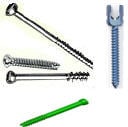
ASTM F2502 is a standard for testing Bioabsorbable Plates and Screws for Internal Fixation Implants.
These types of plates and screws are resorbed into the body once implanted to unstable bone or tissue connected to bone. The advantage over a metallic fixation device is that a bioabsorbable device does not need to be removed. The challenge to medical device manufacturers of bioabsorbable devices is to ensure full healing takes place before the bioabsorbable device is fully deteriorated.
There are four Annexes describing the testing procedures to follow in this specification.
ADMET's Biaxial eXpert 2610 is the perfect testing system solution for performing Annex 1-4

A1-Torsional Properties
- Torsional Yield Strength
- Maximum Torque
- Breaking Angle
Rate of Torsional Speed applied to the sample -1 to 5 rotations/minute
Testing Times -Document 7 measuring points over time. (ie; 1 day, 1 week, 4 weeks, etc.)
Solution -Specimens must be submerged in bath- see conditioning 5.4 and 6.1 and constant temperature of 37^C +-1^
Procedure
- Insert specimen in collet grip- 5 threads or 20% of total size should be anchored in grip.
- Apply torsional load of 1 to 5 r/min to failure.
- Apply minimal axial load to balance grip.
- From Torque vs. angle curve plot calculate Torsional Yield Strength by offset method, report max torque and breaking angle (both determined by max torque reported)


A2- Driving Torque
- Attach specimen to fixture and align with pilot hole.
- Apply 1-5r/min torsional load for 4 rotations (1440 degrees) and 1.14kg or less axial load to maintain screw driver bit in the screw head.
- Record max load in Nm.
- Compare a variety of specimen sizes.
A3-Axial Pullout
- Insert specimen in collet grip- 5 threads or 60% of total length of fully threaded screw.
- Clamp top of screw (head)
- Tension load at 5mm/min until failure or release from test block.
- Plot load vs. displacement - note max load and mode of failure.
A4-Single Cycle Bend Testing
- Load plate onto rollers (roller diameter dependent on plate size, symetry or asymetry, hole spacing)
- Apply load of increasing magnitude by using position control and plot Load vs. Displacement.
Calculate
- Bending stiffness (N/mm)
- Bending strength (N-m)
- Bending structural stiffness EI (N-m*m)
- 0.2% offset displacement (N/mm)
Specifics on the materials and manufacture, conditioning, care and handling of these devices is explained in the full description of this specification. F2502-05
Many who use this method also refer to ASTM F543 A1 and
ASTM F543 A2.
Click on these links for more information...
More Testing News
More Testing Videos
More Testing Specifications
Request a Quote
Ask an Engineer a question
ADMET 1-800-667-3220 www.ADMET.com
Posted by Andrew DeWolfe on Tue, Jul 27, 2010 @ 03:10 PM
Along with ASTM D638, D790 is one of the most commonly used specifications in the plastics industry. This test measures the flexural strength and flexural modulus of reinforced and unreinforced plastics. These calculations allow you to choose materials that do not bend when supporting the loads you require for your application. These calculations relate to the stiffness of your material. The test uses a universal testing machine and a three point bend fixture to bend plastic test bars to acquire the data needed to make the calculations. The calculations and set-up for D790 are more complex and time consuming compared to other tests so please read the entire specification from ASTM before running the test. ISO-180 is similar in concept to this test although the specimen shapes and some other details are slightly different. This is a simple summary to help you determine if this specification is right for you and also to call out what testing equipment is needed.
Test Procedure:
- Die cut, saw, or injection mold your samples to a shape specified in the ASTM Specification.
- If you have a standard shape then you do not need to enter the depth, width, and span length for each test.
- If you have specimens that vary in width and depth then you will need to adjust the span length for each test as well as enter in the new width, depth, and span length as these values are used in the calculations.
- Place the test bar on the 3 point bend fixture and begin the test and end after bending to 5% deflection or until the sample breaks.
Tips:
- Testing speed: The speed of the test is very slow and variable depending on the support span and depth of beam which are used in the calculation used to determine the speed.
- Test end: The test ends when the material has acheived 5% deflection or it breaks. The 5% deflection is determined by a calculation that takes into account the support span and depth of beam.
- Use a standard size test bar if possible! In tensile tests that have samples that are always different sizes all you have to do is enter the width, thickness, and gage length of a sample. However, for D790, variable specimen sizes are more burdensome because not only do you need to enter the specimen size, but you also need to adjust the 3 point bend span length and the speed of test. A standard size allows you to run multiple tests without having to change these parameters.
Equipment Required:
- Universal testing machine
- Capable of constant rate of crosshead speed
- Does not deflect more than 1% of the deflection of the test specimen
- Meet accuracy of testing machines specified in ASTM E4
- Deflection measuring devise.
- This can be the standard crosshead movement indicator or use an auxiliary deflection measuring devise such as a displacement transducer.
- Good testing software.
- Modern software performs all of these calculations automatically after the test. ADMET's version of this would be MTESTQuattro.
Click on these links for more information...
More Testing News
More Testing Videos
More Testing Specifications
Request a Quote
Ask an Engineer a question
ADMET 1-800-667-3220 www.ADMET.com
Posted by Debbi Cohen on Fri, Jun 18, 2010 @ 07:53 AM
ASTM F1264 Annex 3 is a test method for bending fatigue testing of intramedullary fixation devices (IMFD). This cyclic 4 point bend test determines the fatigue life at a specified bending moment or estimates the fatigue strength for a specified number of cycles.
1.) The four point bend fixture should be attached to a Universal Testing System and adjusted as follows;
- The suggested Short and Long Spans in A1.8.1 should be used whenever possible. The two spans listed below are common.
s=c=38mm (1.5in.) L=114mm(4.5in.)
s=c=76mm (3.0in.) L=228mm(9.0in.)
- Guides could be added to the outside edges of the bend fixture to prevent the IMFD from shifting position during testing. The guides must not interfere with load application or specimen deformation.
- If the IMFD is a unique shape or curved be careful to secure the specimen as directed in the full description of this specification. Link below.
IMFD Bone Plates 4-pt. bend fixture
2.) Before starting the multicycle test the load and the #of cycles the test will run, runout, must be determined. There are a few methods to use;
- Test IMFD at different load levels to failure and plot failure loads vs. number of cycles.
- Determine nominal stress through moment analysis using analytical or experimental methods.
- Fatigue Strength Determination- 1 million cycle test to determine maximum moment applied to the IMFD to cause failure.
Using
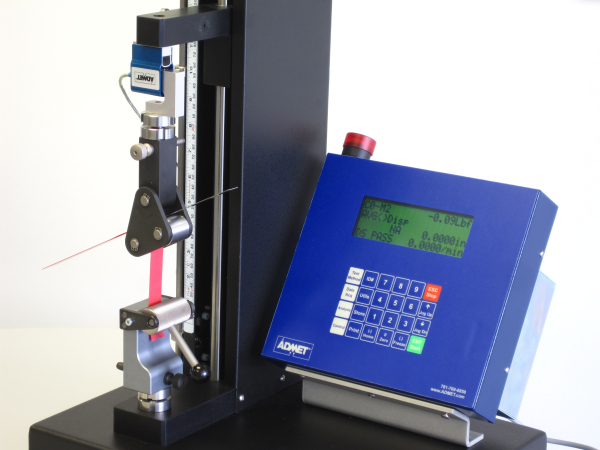
MTESTQuattro, our PC based control system, it is easy to create a variety of testing profiles. This profile is a compression test repeating for multiple cycles.
ASTM F1264-A3 requires you to;
- create a sinusoid cyclic curve at a rate of <=5Hz.
- Record number of cycles as the test is progressing.
- Set limits that will tell the testing system to stop the test when the specimen fails or deviates from intended load.
Recommended system
Click on these links for more information...
More Testing News
More Testing Videos
More Testing Specifications
Request a Quote
Ask an Engineer a question
ADMET 1-800-667-3220 www.ADMET.com
Posted by Debbi Cohen on Mon, Mar 01, 2010 @ 02:23 PM
Metallic Bone Plates need to undergo several tests before gaining approval as internal fixation devices of the skeletal system. One standard, ASTM F382-99, defines the test methods for single cycle bend testing (annex A1) and for determining the bending fatigue properties (annex A2) of metallic bone plates. A summary of the test methods for annex A1 and A2 follows. For a complete description of ASTM F382-99, refer to the specification from the ASTM International organization.
Annex A1- ASTM F382-A1 measures the bending stiffness, bending structural stiffness, and bending strength from a single cycle bend test on a metallic bone plate.
Annex A1 is used to determine values for the mechanical response of bone plates to specific bending loads and provides some insight into the mechanical response of the subject bone plate. The bone plate is positioned on a 4 point bend fixture (shown below) installed in an Universal Testing Machine (UTM). The bend fixture should use cylindrical rollers with diameters between 6-12 mm. The recommended test configuration locates the loading rollers at one third points. The spacing of the rollers, however, is dependent on the location of the screw holes in the bone plate. Apply bending moments of increasing magnitude via crosshead position rate control. Generate a load versus load point displacement graph. Determine the bending stiffness, bending structural stiffness and bending strength.

4 point bend fixture
eXpert 7601 eXpert 2611
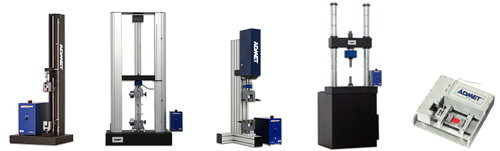
To perform Annex 1, the 4 point bend fixture above can be used on an ADMET eXpert Single or Dual Column Universal Testing Machine Frame. ADMET has 2 types of controllers to set the speed, load, and position limits of the test. (MTESTQuattro and eP digital push button)
Annex A2 - Test Method for determining the bending fatigue properties of metallic bone plates.
This test method is used to determine the fatigue life at a specific or over a range of bending moment levels. It may also be used to estimate the fatigue strength for a specific number of cycles. The bone plate is positioned in a 4 point bend fixture so that a bone plate's section that would normally bridge the fracture site is subjected to a uniform bending moment. The bone plate is subjected to a constant amplitude constant frequency sinusoidal bending moment which is continued until the specimen fails or the runout cycle count is reached. The data generated from each plate test is used to create a M-N diagram (Bending Moment vs Number of Cycles). Typical cyclic frequencies and runout counts are 5 Hz and 1 million cycles, respectively.
Another Intermedullary Fixation Device standards, ASTM F1264, requires a static and fatigue 4 point bend test, as well as a static torsion test. Also, bone screws are subject to standard torsion testing. (ASTM F543 and ASTM F115)
1-800-667-3220 ADMET, Inc. call or email sales@ADMET.com any questions.
Click on these links for more information...
More Testing News
More Testing Videos
More Testing Specifications
Request a Quote
Ask an Engineer a question
ADMET 1-800-667-3220 www.ADMET.com