Contact Us

Call us: (800) 667-3220

Email us: info@ADMET.com

Ask an Engineer form

Request a quote form

Receive an email when a new specification summary is posted

Your email:

About ADMET

  • Founded by engineers in 1989.
  • Offers advanced materials and product testing systems that are reliable and easy to use.
  • Willing to modify our systems to meet your needs.
  • On-site service and calibration team includes over 100 individuals in over 40 locations.
  • On-site and web based training.
  • Unlimited phone and email support.

Authors

Richard Gedney, Founder

Orick Kelley, Sales Engineer for metals, concrete, etc...

Debbi Cohen, Sales Engineer, medical materials and finished device testing applications

Andrew DeWolfe, Sales Engineer for plastics, foam, textiles, etc...


Current Articles | RSS Feed RSS Feed

Testing System for Bioabsorbable Plates and Screws - ASTM F2502

  | Share on Twitter Twitter | Submit to Digg digg it |  Add to delicious  delicious |  Submit to StumbleUpon StumbleUpon |  Share on LinkedIn LinkedIn | Submit to Reddit reddit 

ASTM F2502 is a standard for testing Bioabsorbable Plates and Screws for Internal Fixation Implants.

These types of plates and screws are resorbed into the body once implanted to unstable bone or tissue connected to bone. The advantage over a metallic fixation device is that a bioabsorbable device does not need to be removed. The challenge to medical device manufacturers of bioabsorbable devices is to ensure full healing takes place before the bioabsorbable device is fully deteriorated. 

There are four Annexes describing the testing procedures to follow in this specification. 

ADMET's Biaxial eXpert 2610 is the perfect testing system solution for performing Annex 1-4

              eXpert 2610

A1-Torsional Properties

  • Torsional Yield Strength
  • Maximum Torque
  • Breaking Angle

Rate of Torsional Speed applied to the sample -1 to 5  rotations/minute

Testing Times -Document 7 measuring points over time. (ie; 1 day, 1 week, 4 weeks, etc.)

Solution -Specimens must be submerged in bath- see conditioning 5.4 and 6.1 and constant temperature of 37^C +-1^

Procedure

  1. Insert specimen in collet grip- 5 threads or 20% of total size should be anchored in grip.
  2. Apply torsional load of 1 to 5 r/min to failure.
  3. Apply minimal axial load to balance grip.
  4. From Torque vs. angle curve plot calculate Torsional Yield Strength by offset method,  report max torque and breaking angle (both determined by max torque reported)offset torque yield
                     analysis

A2- Driving Torque

  1. Attach specimen to fixture and align with pilot hole.
  2. Apply 1-5r/min torsional load for 4 rotations (1440 degrees) and 1.14kg or less axial load to maintain screw driver bit in the screw head.
  3. Record max load in Nm.
  4. Compare a variety of specimen sizes.

A3-Axial Pullout

  1. Insert specimen in collet grip- 5 threads or 60% of total length of fully threaded screw.
  2. Clamp top of screw (head) 
  3. Tension load at 5mm/min until failure or release from test block.
  4. Plot load vs. displacement - note max load and mode of failure.

A4-Single Cycle Bend Testing

  • Load plate onto rollers (roller diameter dependent on plate size, symetry or asymetry, hole spacing) 
  • Apply load of increasing magnitude by using position control and plot Load vs. Displacement. 
             bend fixture

Calculate

  1. Bending stiffness (N/mm)
  2. Bending strength (N-m)
  3. Bending structural stiffness EI (N-m*m)
  4. 0.2% offset displacement (N/mm)

Specifics on the materials and manufacture, conditioning, care and handling of these devices is explained in the full description of this specification. F2502-05

Many who use this method also refer to ASTM F543 A1 and 

ASTM F543 A2.


Click on these links for more information...

More Testing News

More Testing Videos

More Testing Specifications

Request a Quote

Ask an Engineer a question

ADMET 1-800-667-3220  www.ADMET.com 

Testing System for ASTM F2267 Body Fusion Device

  | Share on Twitter Twitter | Submit to Digg digg it |  Add to delicious  delicious |  Submit to StumbleUpon StumbleUpon |  Share on LinkedIn LinkedIn | Submit to Reddit reddit 

Spinal Implants and Intervertebral Fusion Devices are tested according to several ASTM standards. ASTM F2267 is intended to provide a basis for the mechanical comparison among past, present and future non-biologic intervertebral body fusion devices. These, sometimes hollow, devices are inserted to promote arthrodesis(fusion) at a given spinal motion segment. Construct are governed by ASTM F1717.  The mechanical tests are conducted using simplified loading schemes and do not attempt to mimic the complex loads of the spine.  An simple outline of the test procedures is as follows:

Axial Compression SubsidenceTest - Metallic Blocks are used to determine stiffness of the device. Polyurethane Blocks are used to determine the likelihood of the part collapsing on itself. Device is secured between 2 blocks.

Stiffness procedure-25mm/min until functional or mechanical failure is obtained.

Subsidence procedure-0.1mm/sec until functional or mechanical failure is obtained.

Both procedures -plot Load vs. Displacement. 

Yield Displacement, Stiffness, Yield Load or Moment, Ultimate Displacement, and Ultimate Load or Moment are to be recorded.

Sampling-
  • 5 samples,
  • polyethylene blocks(1 test) and Metallic blocks(can be reused) used for securing the specimen
  • Push rod (38cm from center of spherical surface)
  • Inferior sphere holds polyurethane block and is fixed to prevent movement.
  • Superior fixture connects to pushrod by minimal friction sphere joint.

Determine Kp by Kp=Ks*Kd/(Kd-Ks)
Kp- Stiffness of Polyurethane Block

Kd-Stiffness of Intervertebral Body Fusion Device

Ks-Stiffness of System

spinal implant set up

ADMET eXpert 2610 5kN or 10kN - Tension/Compression  or Biaxial (shown above) Testing System equipped with MTESTQuattro controller for static tests. System is shown with a multi axis load cell capable of measuring Fx, Fy, Fz and Mz.  

Full version of ASTM F2267 

Click on these links for more information...

More Testing News

More Testing Videos

More Testing Specifications

Request a Quote

Ask an Engineer a question

ADMET 1-800-667-3220  www.ADMET.com 

Testing System for ASTM F2077-03 Intervertebral Body Fusion Device

  | Share on Twitter Twitter | Submit to Digg digg it |  Add to delicious  delicious |  Submit to StumbleUpon StumbleUpon |  Share on LinkedIn LinkedIn | Submit to Reddit reddit 

ASTM F2077-03 is a standard test method for static and dynamic testing of intervertebral body fusion device assemblies. This test method will provide information to compare the mechanical characteristics of different assemblies for different spinal locations and various methods of inserting these assemblies. This standard focuses on all aspects of the spine; cervical, thoracic, and lumber.

This blog post is a quick summary of the full specification. For the full specification details. www.ASTM.org                                                           Neck skeleton 

There are several types of tests performed for ASTM F2077-03; Static and Dynamic Tests.

Static Tests  

    1. Axial Compression Test- Inline Stainless Steel Test Blocks, compress at a rate of 25mm/minute until failure.
    2. Compression Shear Test-Inferior fixture designed to orient the initial position of the intervertebral device Z axis at 45 degrees flexion relative to the push rod's axis. Pull at rate of 25mm/minute until failure.
    3. Torsion Test- Inline, Pushrod connected to superior fixture by a spherical gimbal mechanism, Twist at a rate of 60 degrees/minute until failure. Compressive preloads of 100N, 300N, and 500N are required for this test.
ANALYSIS
  • Record Load vs. Displacement or Torque vs. Angle
  • Yield Displacement/Angle
  • Stiffness
  • Yield Load/Torque
  • Ultimate Display
  • Ultimate Load/Torque                    

Dynamic / Fatigue Tests- Polyacetal Test Blocks with appropriate matching geometry to Intervertebral Body Fusion Device Assembly. 

  1. Need at least six data points- Max loads for initial fatigue tests are 25%, 50%, 75% of Ultimate Static load determined above.
  2. Plot semi log- load/torque vs. number of cycles to failure
  3. Max runout load/torque is determined.
  • R-Value of 10 should be used for axial compression & compression shear tests. R value of -1 for Torsion Tests.
  • Frequency <=10Hz according to Index X1.9 ( see specification full listing at www.ASTM.org)

                        Biaxial Testing System

ADMET recommends our eXpert 2600 series Biaxial Testing System equipped with our PC based, MTESTQuattro control software for ASTM F2077 testing. Custom fixtures available upon request. All ADMET testing systems come with free lifetime technical support and free startup online training. 1-800-667-3220 for more information and to receive a quote.


Click on these links for more information...

More Testing News

More Testing Videos

More Testing Specifications

Request a Quote

Ask an Engineer a question

ADMET 1-800-667-3220  www.ADMET.com 

How to Perform an Adhesive Strength T-Peel Test - ASTM D1876

  | Share on Twitter Twitter | Submit to Digg digg it |  Add to delicious  delicious |  Submit to StumbleUpon StumbleUpon |  Share on LinkedIn LinkedIn | Submit to Reddit reddit 

There are many test methods used to determine the strength of an adhesive including peel, shear, cleavage, and tension tests.  Peel tests are common for tapes, labels, coatings, and other bonded materials.  There are three main types of peel tests including 90 degree peel test, 180 degree peel test, and a T-Peel test.  The Loop Tack test is similar in concept but is better classified as a tension test.

Why would you perform the T-Peel test instead of the 90 or 180 degree test?  Well, the 90 and 180 degree tests are commonly used where a flexible material with an adhesive or other bonding method is adhered to a more rigid substrate.  You would use the 90 over the 180 degree peel test if your flexible substrate can't be bent cleanly back to 180 degrees.  The T-Peel is used when both materials are either similar or both flexible.

The T-peel test requires that both of the bonded substrates are flexible.  This means that they need to be able to be bent up to a 90 degree angle without breaking.  Both substrates do not need to be the same material.

Below is a video of the T-Peel test.  If you want to see videos of the other peel tests, use these links: 90 degree peel, 180 degree peel, Loop Tack, Package Peel Strength ASTM F88, T-Peel Tissue Adhesives ASTM F2256.

This is a quick summary of the ASTM D1876 specification to decide if this test is right for you, and to point out what equipment you need to perform the test.

Equipment Required:

  1. Universal Testing MachineASTM D1876 T-Peel Test Setup on a Universal Testing Machine
    1. 1 kN capacity single column UTM is usually enough for this test.
    2. Servo controlled to keep a constant rate of speed.
  2. Tensile Grips (2)
    1. Each peel substrate needs to be held securely
  3. Software to calculate peak load and average load between extension points

Test Procedure

  1. Load each end of the sample into opposing tensile grips
  2. Separate grips at a constant rate of speed (see spec) throughout the length of the specimen (about 9 inches)
  3. Report peak load and average load per unit width of bond

ASTM D1876 T Peel Test Report

For reference to ASTM F2256 blog post on T-Peel adhesive bond testing.

Click on these links for more information...

More Testing News

More Testing Videos

More Testing Specifications

Request a Quote

Ask an Engineer a question

ADMET 1-800-667-3220  www.ADMET.com 

How to perform ASTM D3577 Medical Elastomer & Rubber Glove Test

  | Share on Twitter Twitter | Submit to Digg digg it |  Add to delicious  delicious |  Submit to StumbleUpon StumbleUpon |  Share on LinkedIn LinkedIn | Submit to Reddit reddit 

In the ASTM acceptance standard for testing rubber surgical gloves (D3577) and rubber medical gloves (D3578), made of latex, vinyl, and nitrile. The standard describes the standard size, material properties, physical and mechanical property acceptance levels, aqueous protein and antigen protein content, and visual inspection required for a glove to be used in a medical procedure. Other relevant standards include ASTM D6319, ASTM D5250, EN 455-2, ISO 11193-1:2002, and ISO/AWI 11193-2. 

        single column     eXpert 2610

ADMET Single Column Testing  and  Dual Column Testing Systems can be used to test the physical and mechanical properties of the gloves.

Summary:

Classificationmedical glove

Type 1 - Gloves compounded primarily from natural rubber latex.

Type 2 - Gloves compounded from a rubber cement or from synthetic rubber latex

Sampling reference- ISO2859 and Table 1-ASTM D3577 full spec.

Referee Tests;

  • Sterility Test
  • Freedom from Holes
  • Physical Dimensions Test
  • Precision and Bias
  • Physical Requirements Test
  1. Gloves will be tested according to ASTM D412.(Testing video)
  2. The Gloves are then put in heating chambers and undergo Accelerated Aging according to ASTM D573. (One can follow option a or b)   

a)70 +-2 degrees Celsius for 22+-0.3 hours.

b)100+-2 degrees Celsius for 22+-0.3 hours.

After accelerated aging, the gloves must be tested to determine Tensile Strength and Elongation. The ideal limits are in the Table below.

Type  Tensile Strength Elongation 500% Elongation

Type 1 
Before Aging

24 MPa, min 750%, min 5.5MPa, max

Type 1 
After Aging

18 MPa, min 560%, min  

Type 2
Before Aging

17MPa, min 650%, min 7.0MPa, max

Type 2
After Aging

12MPa, min 490%, min  


  • Precision and Bias are specified in ASTM D412.
  • Powder Free Gloves residue determined by ASTM D6124.
  • Aqueous Extractable Protein Content determined by ASTM D5712.
  • Powdered Glove residue determined by ASTM D6124.
  • Antigenic Protein Content determined by ASTM D6499.
  • Dimensions and Tolerance Chart labeled Table 2 describes the length, width, and thickness sizes that are acceptable to this standard.

Equipment required:

1. Universal testing machine (tensile testing machine) with these minimum specifications: Single Column eXpert 7600 series, Dual Column eXpert 2600 series
A. Servo-controlled to keep a constant rate of speed during the test (+/- 2 inches/min)
B. At least 30 inches of crosshead travel or more for high elongation materials.
C. MTESTQuattro PC Based data acquisiton, data analysis, and reporting software. MTESTQuattro allows viewing real time XY plot, data report showing a description of the glove, tensile strength, elongation, and comments, as well as a statistical summary of multiple samples following the same test procedure.

D. Video or laser extensometers may be employed to increase the accuracy of the elongation calculations.

This is a summary of the standard. For a full, detailed description go to the ASTM website.

medical glove testing

Click on these links for more information...

More Testing News

More Testing Videos

More Testing Specifications

Request a Quote

Ask an Engineer a question

ADMET 1-800-667-3220  www.ADMET.com 

How to Perform an Adhesive Lap Joint Shear Strength Test - ASTM D1002

  | Share on Twitter Twitter | Submit to Digg digg it |  Add to delicious  delicious |  Submit to StumbleUpon StumbleUpon |  Share on LinkedIn LinkedIn | Submit to Reddit reddit 

Shear joints impose uniform stresses across the bond area which results in the highest possible joint strength.  ASTM D1002 is commonly performed to measure the shear strength of adhesives that are used to bond metals.  This test is similar to ASTM D3163 which is for adhesives that bond rigid plastic substrates, and also ASTM D3164 which is for plastic adhesives that are used to bond both plastic and metal substrates.  All three of theseTypes of Shear Joints specifications use a single lap joint (lap shear) specimen to determine the shear strength of adhesives.  If you are going to perform this test, you should read the entire specification from ASTM. This is a quick summary to decide if this test is right for you, and to point out what equipment you need to perform the test.  Some of the content in this blog was taken from ADMET's shear testing article in Quality Magazine.

Test Procedure:

  1. Measure the amount of shear area in square inches or square centimeters.
  2. Load each end of the specimen in the tensile grips.
  3. Apply a force at a controlled rate to the specimen until it breaks and record the maximum force and type of joint failure. 
    1. ASTM D1002 specifies a load control rate of 1,200 to 1,400 psi/minute. A cross head control rate of 0.05 inch/minute approximates the loading rate and also is an acceptable mode of control.

Test Report:

  1. Maximum force
  2. Maximum shear stress
    1. Divide the maximum force by the shear area and reportLap Shear Test Specimen in units of kilogram/square centimeter or psi.
  3. Type of failure (separation from adhesive to substrate, separation through the adhesive, or both)

 Equipment required:

  1. Universal testing machine (tensile testing machine) with these minimum specifications:
    1. Servo-controlled to keep a constant rate of speed during the test.
    2. Breaking load should be between 15 and 85% of machine capacity.  This rule may be antiquated as there should be no trouble going to the full scale capacity of a machine.  Many strong adhesives require a 10,000 pound (50kN) capacity testing machine (ADMET eXpert 2613).  Most common is a 2,000 pound (10kN) testing machine (ADMET eXpert 2611).
  2. Software or suitable electronics are required to operate the machine, report peak load, and provide a force / displacement chart.ADMET Dual Column Universal Testing Machine
  3. Grips: Vise grips with serrated inserts are commonly used for lap shear tests. The serrated grip inserts are designed to dig into the material and prevent it from slipping. If slippage occurs with a vice grip, self-tightening grips of pneumatic or wedge design may be used. The grip inserts should be aligned so that the centerline of the grip assembly is aligned with the adhesive bond. Proper alignment is achieved with vice grips by adjusting the grip inserts from side to side so that the center line of the upper and lower grips pass through the adhesive.


Other common adhesive shear specifications:

ASTM D905 - Strength Properties of Adhesive Bonds in Shear by Compression Loading
ASTM D906 - Strength Properties of Adhesives in Plywood Type Construction in Shear
ASTM D1002 - Apparent Shear Strength of Single-Lap-Joint Adhesively Bonded Metal Specimens
ASTM D2293 - Creep Properties of Adhesives in Shear by Compression Loading
ASTM D2294 - Standard Guide for Use of Adhesive-Bonded Single Lap-Joint Specimen Test Results
ASTM D2295 - Strength Properties of Adhesives in Shear by Tension Loading at Elevated Temperatures
ASTM D2339 - Strength Properties of Adhesives in Two-Ply Wood Construction in Shear
ASTM D2557 - Tensile-Shear Strength of Adhesives in the Subzero Temperature Range from -267.8 to -55 C
ASTM D2919 - Determining Durability of Adhesive Joints Stressed in Shear by Tension Loading
ASTM D3163 - Determining Strength of Adhesively Bonded Rigid Plastic Lap-Shear Joints in Shear
ASTM D3164 - Strength Properties of Adhesively Bonded Plastic Lap-Shear Sandwich Joints in Shear
ASTM D3165 - Strength Properties of Adhesives in Shear  Single-Lap-Joint Laminated Assemblies
ASTM D3166 - Fatigue Properties of Adhesives in Shear by Tension Loading (Metal/Metal)
ASTM D3528 - Strength Properties of Double Lap Shear Adhesive Joints by Tension Loading
ASTM D3931 - Determining Strength of Gap-Filling Adhesive Bonds in Shear by Compression
ASTM D4027 - Measuring Shear Properties of Structural Adhesives by the Modified-Rail Test
ASTM D4498 - Heat-Fail Temperature in Shear of Hot Melt Adhesives
ASTM D4501 - Shear Strength of Adhesive Bonds Between Rigid Substrates by the Block-Shear Method
ASTM D4562 - Shear Strength of Adhesives Using Pin-and-Collar Specimen
ASTM D5656 - Thick-Adhered Metal Lap-Shear Joints for the Stress-Strain Behavior
ASTM D5868 - Lap Shear Adhesion for Fiber Reinforced Plastic (FRP) Bonding
ASTM D6463 - Time to Failure of Pressure Sensitive Articles under Sustained Shear Loading

Click on these links for more information...

More Testing News

More Testing Videos

More Testing Specifications

Request a Quote

Ask an Engineer a question

ADMET 1-800-667-3220  www.ADMET.com 

ISO 594/1 - Torsion Testing Equipment -Torque, Axial Load, Leak

  | Share on Twitter Twitter | Submit to Digg digg it |  Add to delicious  delicious |  Submit to StumbleUpon StumbleUpon |  Share on LinkedIn LinkedIn | Submit to Reddit reddit 

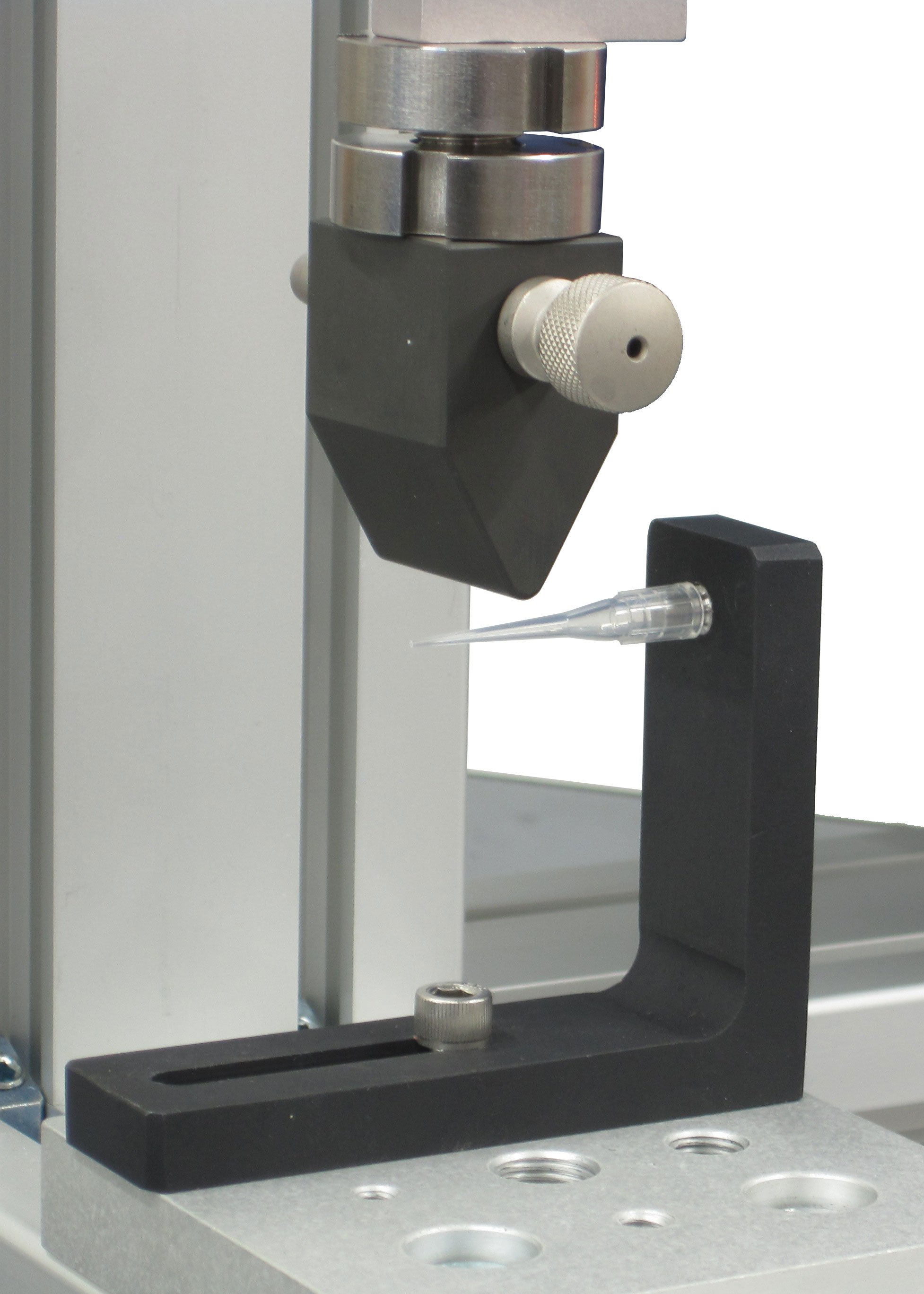
ISO 594/1 describes dimensions, testing profile, and parameters for testing conical fittings with a 6% (luer) taper for hypodermic syringes, needles, and certain other medical equipment, such as transfusion and infusion sets. This standard covers rigid and semi-rigid materials for gauging and performance.  

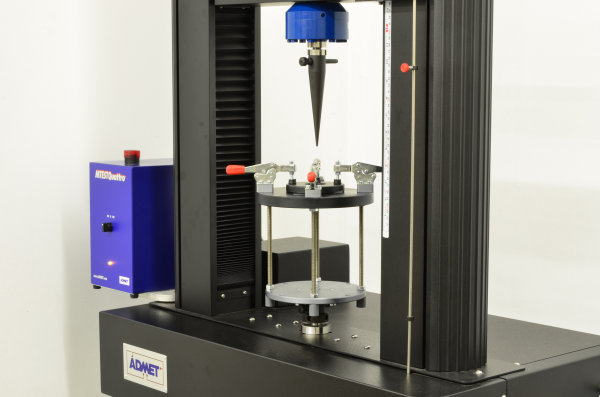
Horizontal Torque Tester


Vertical Torque Tester


Several mechanical tests in section 5, figures 4+5 require torque testing.

Section 5.2 

  • First, according to figures 4 + 5, connect fitting to steel male or female reference fitting.
  • Assemble components by applying an axial force of 27.5 Newtons (6.18 lbf) for 5 seconds while applying a torsional force < or = 0.1Nm (.88 lb-in) and < or = to 90 degrees.
  • Introduce water
  • Expel Air
  • Check to determine if outside of fitting is dry
  • Seal the outlet - bring internal pressure to 300kPa.
  • Maintain pressure 30 seconds. 
**Highlights on the Torsion Requirements for Section 5.3.1.1 and 5.5.1.

 * Apply axial force of 25N for 5 seconds simultaneously applying 0.1Nm to an end limit of 90 degrees. Full description of ISO 594/1-1986 is necessary to complete this test. 

          Torsion collage 

ADMET offers a vertical or horizontal 81T Torsion Testing System. to meet the Torsion requirements of this standard. ADMET's full line of standard testing systems can be tailored or modified to meet the additional requirement of ISO 594/1. 

Ask an Engineer a Question

Testing News

Testing Videos

ADMET home 

 single, dual, biaxial


Click on these links for more information...

More Testing News

More Testing Videos

More Testing Specifications

Request a Quote

Ask an Engineer a question

ADMET 1-800-667-3220  www.ADMET.com 

Flexural Fatigue- ASTM F1264-A3 Fixation Device -IMFD

  | Share on Twitter Twitter | Submit to Digg digg it |  Add to delicious  delicious |  Submit to StumbleUpon StumbleUpon |  Share on LinkedIn LinkedIn | Submit to Reddit reddit 

ASTM F1264 Annex 3 is a test method for bending fatigue testing of intramedullary fixation devices (IMFD). This cyclic 4 point bend test determines the fatigue life at a specified bending moment or estimates the fatigue strength for a specified number of cycles.

1.) The four point bend fixture should be attached to a Universal Testing System and adjusted as follows;

  • The suggested Short and Long Spans in A1.8.1 should be used whenever possible. The two spans listed below are common.
 s=c=38mm (1.5in.) L=114mm(4.5in.)
 s=c=76mm (3.0in.) L=228mm(9.0in.)

 
  • Guides could be added to the outside edges of the bend fixture to prevent the IMFD from shifting position during testing. The guides must not interfere with load application or specimen deformation.
  • If the IMFD is a unique shape or curved be careful to secure the specimen as directed in the full description of this specification. Link below.

      bone fixation  bone plate assortment  4 point bend 

         IMFD    Bone Plates             4-pt. bend fixture

2.) Before starting the multicycle test the load and the #of cycles the test will run, runout, must be determined. There are a few methods to use;

  • Test IMFD at different load levels to failure and plot failure loads vs. number of cycles. 
  • Determine nominal stress through moment analysis using analytical or experimental methods.
  • Fatigue Strength Determination- 1 million cycle test to determine maximum moment applied to the IMFD to cause failure.
 Using MTESTQuattro, our PC based control system, it is easy to create a variety of testing profiles. This profile is a compression test repeating for multiple cycles.
 
ASTM F1264-A3 requires you to;
  • create a sinusoid cyclic curve at a rate of <=5Hz. 
  • Record number of cycles as the test is progressing.
  • Set limits that will tell the testing system to stop the test when the specimen fails or deviates from intended load.
Recommended system
ADMET eXpert 7603, single column testing system or ADMET eXpert 2610, dual column testing system both equipped with MTESTQuattro data acquisition, analysis, and control system and with a 4-point bend fixture. This system can be equipped with a Torque Actuator to create a biaxial testing system capable of servo control of load, position, torque and angle.


Click on these links for more information...

More Testing News

More Testing Videos

More Testing Specifications

Request a Quote

Ask an Engineer a question

ADMET 1-800-667-3220  www.ADMET.com 

How to Perform an Adhesive Loop Tack Strength Test - ASTM D6195

  | Share on Twitter Twitter | Submit to Digg digg it |  Add to delicious  delicious |  Submit to StumbleUpon StumbleUpon |  Share on LinkedIn LinkedIn | Submit to Reddit reddit 

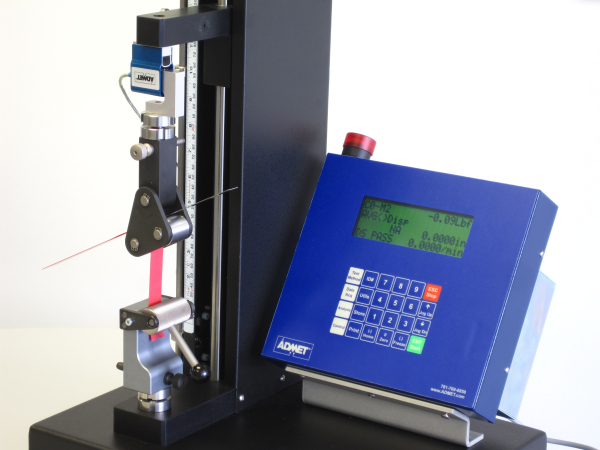
One method to measure the tack force / strength of an adhesive is to perform the "Loop Tack" test method described in specification ASTM D6195.  The adhesives tested with this test are typically pressure sensitive adhesives (PSA) applied to films, labels, tapes, and stickers where the initial tack force is an important characteristic of the product.  The specification describes two ways to perform the test.  One method (Method B) uses a single purpose machine.  Although the simplicity of one dedicated machine is nice, the loop tack method is uncommonly the sole test of any manufacturer.  The other method (Method A) uses a universal testing machine otherwise known as a tensile testing machine.  Using this method provides you with accurate test results, the same ease of use as the single purpose machine, and also allows you to use the universal testing machine for many other common adhesive and material tests such as 90 degree peel adhesion tests, 180 degree peel adhesion tests, and standard tensile strength testing.  If you only need to perform the loop tack test you should consider a single purpose machine and follow Method B.  If you have a tensile testing machine, or need to perform other adhesive and material tests, you should follow Method A.

This is a short video of the test followed by a simple summary to help determine if this test is right for your application.  Please read the entire ASTM specification if you decide to perform the test.


Procedure:

1. Make a loop with your tape with the adhesive on the outside of the loop.

2. Place the loop in the top grip of the universal testing machine.

3. Bring the loop into contact with a 1" cube fastened to the bottom of the universal testing machine.

4. Remove the tape from the 1" cube fixture.

5. Report the peak and/or the average force during removal.

ASTM D6195 Loop Tack Adhesive Test

Test performed on an ADMET eXpert 7601 universal testing machine. 

ASTM D6195 Adhesive Loop Tack Test Report


Test report generated from ADMET's MTESTQuattro testing software.

Click on these links for more information...

More Testing News

More Testing Videos

More Testing Specifications

Request a Quote

Ask an Engineer a question

ADMET 1-800-667-3220  www.ADMET.com 

How to Perform a Rubber & Elastomer Tear Strength Test - ASTM D624

  | Share on Twitter Twitter | Submit to Digg digg it |  Add to delicious  delicious |  Submit to StumbleUpon StumbleUpon |  Share on LinkedIn LinkedIn | Submit to Reddit reddit 

The tear strength of thermoset rubbers, thermoplastic elastomers, and silicones can be measured according to specification ASTM D624.  The test measures the strength required to initiate a tear in a material.  D624 describes multiple different types of sample shapes that can be tested in a standard universal testing machine (tensile testing machine).  Usually materials that are tested to D624 are also tested according to specification ASTM D412 to measure the tensile strength and elongation.  If you are going to perform this test, you should read the entire specification from ASTM. This is a quick summary to decide if this test is right for you, and to point out what equipment you need to perform the test.

This video shows how to perform a tear strength test:


Test Procedure:

  1. Cut or injection mold your material into one of the tear shapes shown in the specification.  Specimen B and C are the most common.
  2. Measure the width of the specimen  
  3. Load the specimen into tensile grips.
  4. Begin the test by separating the tensile grips at a speed of 20 inches per minute
  5. End the test after sample break (rupture)

 Analysis obtained: 

  1. Tear Strength - lb/in unit. (Peak load observed during test / thickness of material)

Equipment required (same as ASTM D412 machines):

1. Universal testing machine (tensile testing machine) with these minimum specifications:

  • Servo-controlled to keep a constant rate of speed during the test of at least 20in/min (+/- 2 inches/min)
  • At least 30 inches of crosshead travel or more for high elongation materials
  • Most small and common 1kN (225 pound) are fine for this test (see ADMET eXpert 7601).

 2. Software or suitable electronics are required to operate the machine and to take the measurements. Basic systems will provide the raw data, and stress-strain charts. Using these sources of data, you can calculate tear strength yourself (peak load / material thickness). However, fully PC based systems have the capability to calculate all of these automatically such as our MTESTQuattro testing software which has built in support for ASTM D624.  Using this system would provide you with the tear strength immediately after performing the test.

3. Tensile grips hold your specimen during the test as it is being pulled apart. Rubbers and elastomers usually lend themselves to being easily held in a variety of grip designs such as manual vise grips, pneumatic grips, wedge grips, or eccentric roller designs. 

Click here if you are also interested in ASTM D412 tensile strength and elongation testing.

ASTM D624 Die C Specimen in Tensile Grips 

D624 Specimen Die C


ADMET eXpert 7601 Single Column Testing Machine

ADMET eXpert 7601 


Click on these links for more information...

More Testing News

More Testing Videos

More Testing Specifications

Request a Quote

Ask an Engineer a question

ADMET 1-800-667-3220  www.ADMET.com 

All Posts