Metallic Bone Plates need to undergo several tests before gaining approval as internal fixation devices of the skeletal system. One standard, ASTM F382-99, defines the test methods for single cycle bend testing (annex A1) and for determining the bending fatigue properties (annex A2) of metallic bone plates. A summary of the test methods for annex A1 and A2 follows. For a complete description of ASTM F382-99, refer to the specification from the ASTM International organization.
Annex A1- ASTM F382-A1 measures the bending stiffness, bending structural stiffness, and bending strength from a single cycle bend test on a metallic bone plate.
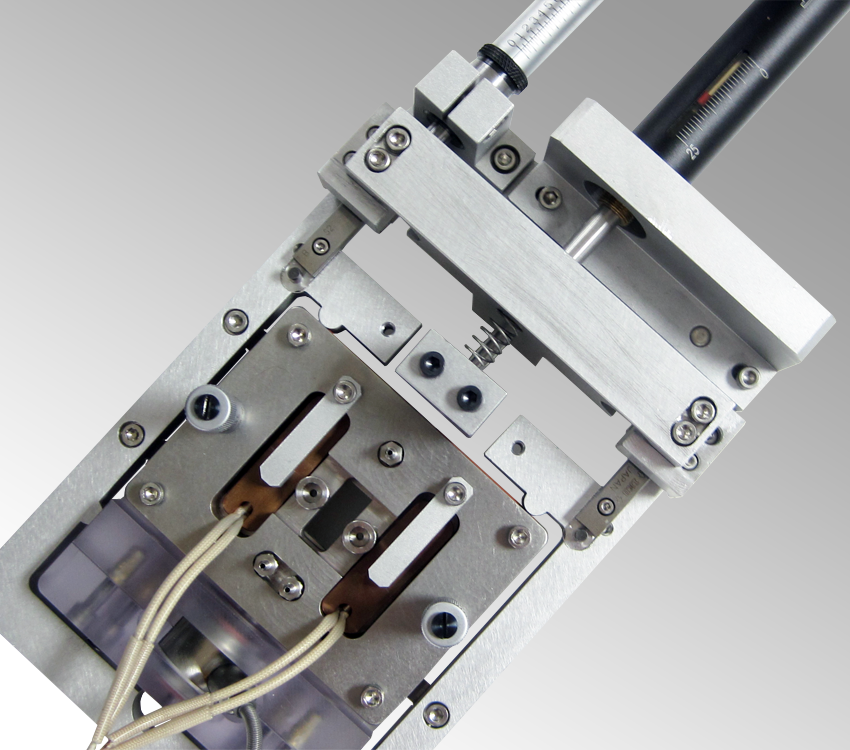
Annex A1 is used to determine values for the mechanical response of bone plates to specific bending loads and provides some insight into the mechanical response of the subject bone plate. The bone plate is positioned on a 4 point bend fixture (shown below) installed in an Universal Testing Machine (UTM). The bend fixture should use cylindrical rollers with diameters between 6-12 mm. The recommended test configuration locates the loading rollers at one third points. The spacing of the rollers, however, is dependent on the location of the screw holes in the bone plate. Apply bending moments of increasing magnitude via crosshead position rate control. Generate a load versus load point displacement graph. Determine the bending stiffness, bending structural stiffness and bending strength.


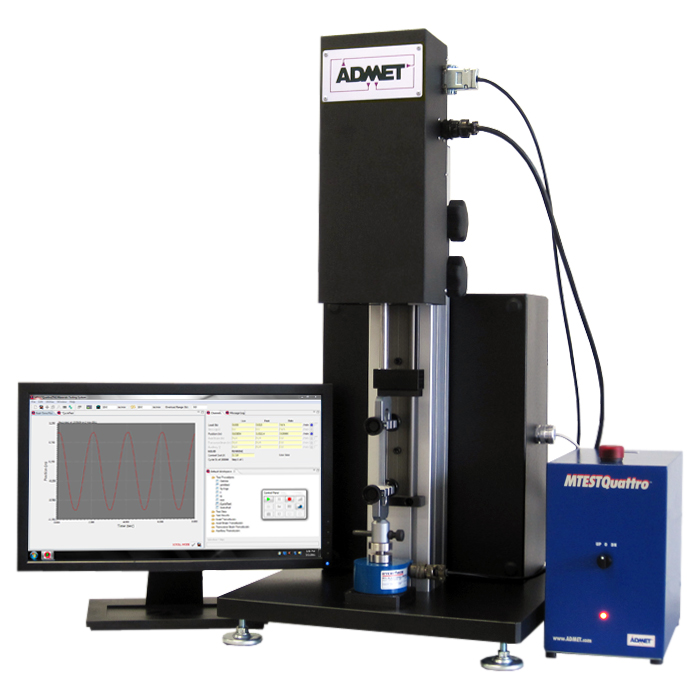
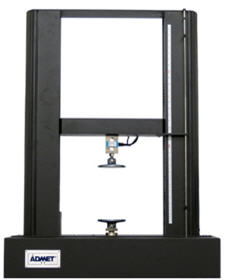
To perform Annex 1, the 4 point bend fixture above can be used on an ADMET eXpert Single or Dual Column Universal Testing Machine Frame. ADMET has 2 types of controllers to set the speed, load, and position limits of the test. (MTESTQuattro and eP digital push button)
Annex A2 - Test Method for determining the bending fatigue properties of metallic bone plates.
This test method is used to determine the fatigue life at a specific or over a range of bending moment levels. It may also be used to estimate the fatigue strength for a specific number of cycles. The bone plate is positioned in a 4 point bend fixture so that a bone plate's section that would normally bridge the fracture site is subjected to a uniform bending moment. The bone plate is subjected to a constant amplitude constant frequency sinusoidal bending moment which is continued until the specimen fails or the runout cycle count is reached. The data generated from each plate test is used to create a M-N diagram (Bending Moment vs Number of Cycles). Typical cyclic frequencies and runout counts are 5 Hz and 1 million cycles, respectively.
Another Intermedullary Fixation Device standards, ASTM F1264, requires a static and fatigue 4 point bend test, as well as a static torsion test. Also, bone screws are subject to standard torsion testing. (ASTM F543 and ASTM F115)
1-800-667-3220 ADMET, Inc. call or email sales@ADMET.com any questions.
Spinal Implants are tested according to several ASTM standards. ASTM F1717 is intended to provide a basis for the mechanical comparison among past, present and future spinal implant assemblies. Three static and one fatigue mechanical test of a spinal construct are governed by ASTM F1717. The three static tests are compression bending, tension bending and torsion. The fatigue test is a compression bending test. The mechanical tests are conducted using simplified loading schemes and do not attempt to mimic the complex loads of the spine. An outline of the four test procedures is as follows:
Static Compression Bend Test - Load at a crosshead displacement rate not to exceed 25 mm/min and record the load vs displacement curve. Calculate displacement at 2% offset yield, elastic displacement, compressive bending yield load, compressive bending stiffness, compressive bending ultimate displacement and ultimate load.
Static Tension Bend Test - Load at a crosshead displacement rate not to exceed 25 mm/min. and record the load vs displacement curve. Calculate displacement at 2% offset yield, elastic displacement, tensile bending yield load, tensile bending stiffness, tensile bending ultimate displacement and ultimate load.
Static Torsion Test - Load at a rate not to exceed 60 deg/min and record the torque vs angle curve. Calculate angle at 2% offset yield, elastic angle, yield torque and torsional stiffness.
Compressive Bending Fatigue Test - Apply a constant load amplitude sinusoidal control profile at no faster than 5Hz. A constant load ratio, R, for all tests should be established and should be greater than or equal to 10. Evaluate two specimens at the initial fatigue loads. Determine the maximum run out load based on no samples failing prior to 5 million cycles. Continue fatigue testing pairs of specimens until the difference between the load at which a specimen fails and the run out load is no greater than 10% of the compression bending ultimate load.
ADMET biaxial universal testing systems are available for static only or for both the static and fatigue tests outlined above. These tests require specific fixturing described in the F1717 specification and can be provide by ADMET.

ADMET eXpert 2610 5kN - 10Nm Biaxial Tension, Compression, and Torsion Testing System equipped with the MTESTQuattro controller for static tests. System is shown with a multi axis load cell capable of measuring Fx, Fy, Fz and Mz.
The Orthopedic Tissue Engineering and Materials Lab at the University of North Carolina Charlotte (UNCC) was the winner of ADMET, Inc's 20 year anniversary celebration biomedical testing system giveaway. Drs. Ahmed El-Ghannam and Nigel Zheng at UNCC head a research team involved with the use of bioactive ceramic and bioactive ceramic-polymer composites as orthopedic fixation devices. To fulfill their testing needs, ADMET has awarded the team an eXpert 81T 20 Nm (177 in-lb) Vertical Torsion Testing System equipped with the PC based MTESTQuattro® Materials Testing System and an immersion bath.

ADMET eXpert 81T Vertical Torsion Testing System for testing bioabsorbable bone screws according to ASTM F2502.
Drs. El-Ghannam and Zheng will use the torsion machine for testing bioactive ceramic-polymer composite orthopedic fixation devices according to ASTM F2502 Annex A1 & A2. Test method F2502-A1is used to measure torsional yield strength, maximum torque and breaking angle; while F2502-A2 is used to measure insertion torque for the bioactive screws.
Example torque vs. angle plot of a screw twisted to failure. Included on the plot is the 2 deg offset yield line.
You can find more information on bone screw torque testing at ADMET's Biomedical webpage.
More testing news...
More testing videos...
Ask an engineer a question- click here
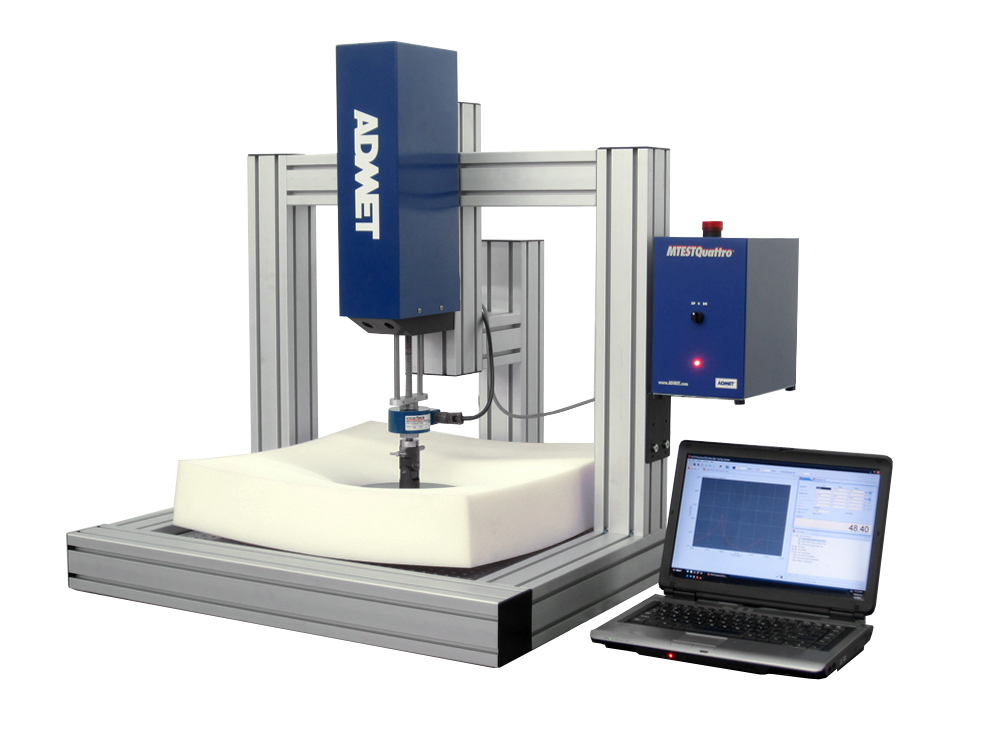
ASTM D3574 (D 3574) applies to slab, bonded, and molded flexible cellular urethane foams. There are many tests in this specification including tests for density, ball rebound, airflow, etc. However, the most common tests in the specification are these mechanical tests:
1. Test B1 - Indentation Force Deflection Test (IFD) - Specified Deflection
2. Test B2 - Indentation Force Deflection Test (IFD) - Specified Force
3. Test C - Compression Force Deflection (CFD)
4. Test E - Tension Test
5. Test F - Tear Resistance Test
All of these tests are performed on a universal testing machine, often times referred to as a tensile testing machine. The machine control software must be capable of segmented machine control testing profiles. Not all testing machines will perform these tests correctly; All ADMET testing machines equipped with MTESTQuattro software are capable of these tests.
Other equipment needed to perform the tests described above are:
Tests B1, B2, C
1. Circular 8" compression platen with a swivel joint
2. Square 16" x 16" (min.) compression platen with 6.5mm holes on 20mm centers
Tests E, F
1. Manual or pneumatic vise grips with serrated inserts
That is the end of the equipment requirements.
The videos below show Foam IFD, Tear, and Tensile Tests. Use the links above each video to read more about each test.
Indentation Force Deflection Test
Foam Tensile Strength Test
Foam Tear Resistance Test
Click here if you would like to ask an engineer a question, or click here if you would like a quote on a system.
ASTM F543 Annex A1 is used to determine the Torsional Properties of Metallic Bone Screws. The results obtained from this test bear no direct correlation to the torque required to insert a bone screw in human or animal bone. This method is used as a quality control check for maintaining product uniformity or to compare the mechanical properties of different, yet similarly sized, products.
Annex A1 is used to measure torsional yield strength, maximum torque and angle at break for metallic bone screws. A description of the ASTM F543-A1 test procedure is as follows:
- Clamp the specimen in a holding device so that five threads below the head of the screw are exposed. The clamping mechanism should prevent screw rotation. Refer to the ASTM specification if the screw is partially threaded or is too small.
- Drive the specimen at 1-5 rpm in the direction of insertion using an appropriate sized screwdriver bit by applying a torsional force until break. If an axial load is required to maintain the screwdriver bit in the screw head, its value should be recorded.
- Analysis: a) Torsional Offset Yield Strength is determined at 2 degrees offset using the torque versus angle of rotation curve. b) Maximum Torque is determined by the largest value on the torque versus angle of rotation curve. c) Breaking Angle is the point at which torque portion of the curve demonstrates its most rapid descent to total failure.
The embedded video demonstrates the use of an ADMET 81T Vertical Torsion Tester for determining offset yield torque, maximum torque and angle at break according to ASTM F543-A1. The torsion test apparatus is rated for 20Nm and is equipped with ADMET's MTESTQuattro® PC based Torsion Testing Software.
You can find more information on bone screw torque testing at ADMET's Biomedical page.
One of the most common specifications that our customers follow is ASTM D882 which is the Standard Test Method for Tensile Properties of Thin Plastic Sheeting. This test is very similar to the common ASTM D638 test whereby plastic material is pulled until in breaks in order to measure elongation, tensile modulus, tensile yield strength, and tensile strength at break. However, it is designed specifically for thin sheeting and film less than 1 mm (0.04") thick.
.
The nice part about ASTM D 882 is that the specimens are strips of film that are 1" wide by 6" long and are not "dumbbell" or "dog bone" shaped. The flat geometry of the specimens and the typical characteristic of films having high elongation allow most users to avoid using an extensometer which allows them to reduce the cost of the testing system and simplifies their testing regimen.
The two main things to keep in mind in regards to equipment are the height of the testing machine and having grips designed to hold the thin film correctly. We always recommend our eXpert 7601single column test machine with 29" of crosshead travel for films with less than 300% elongation and our 53" model for really high elongation films that elongate up to 900%. The grips we recommend are pneumatic vise grips with rubber coated inserts. The rubber coated inserts help to keep the film from prematurely breaking at the grip edge, and in combination with the constant pneumatic pressure the film is prevented from slipping out of the grips during the test. We use foot pedals to allow the operator to open and close the grips with their feet because thin films usually require both hands to line everything up properly. If you have a 30" crosshead travel machine, the grips and load cell will take up about 12" of that travel, and the material being tested will take up another 4" (gage length). This leaves 14" of testing travel which will be fine for materials with less than 350% elongation (14" crosshead travel / 4" original gage length = 3.5 * 100% = 350%) A 54" crosshead travel machine is better suited for materials that have elongation up to 950%
We are always available to answer your questions. Should you have any questions, please feel free to call us @ 800-667-3220 or visit our website for more information.
eXpert 7601 Pneumatic Vise Grip Foot Pedal
ASTM F543 Annex A2 is used to measure the torque required to drive a bone screw into a test block made of a rigid unicellular polyurethane foam. The results obtained from this test bear no direct correlation to the torque required to insert a bone screw in human or animal bone. This method is used as a quality control check for maintaining product uniformity.
The basic test procedure for determining the insertion and removal torque is as follows:
- Clamp the test block with a pre-drilled pilot hole into the machine.
- Drive the bone screw into the test block at a rate between 1 and 5 rpm. The insertion torque will be the maximum torque measured within the first four revolutions of the bone screw.
- Reverse direction and record the maximum removal torque during the four revolutions required to remove the bone screw.
Note: A 1.14 kg (2.5 lb) or less axial force should be applied to maintain engagement between the screw head and drive bit.
The embedded video demonstrates the ADMET E81 Torsion Tester recording the insertion and removal torque of a bone screw according to ASTM F543-A2. The test apparatus is a 20Nm capacity vertical torsion tester equipped with ADMET's MTESTQuattro® PC based Torsion Testing Software.
You can find more information on bone screw torque testing at ADMET's Biomedical page